
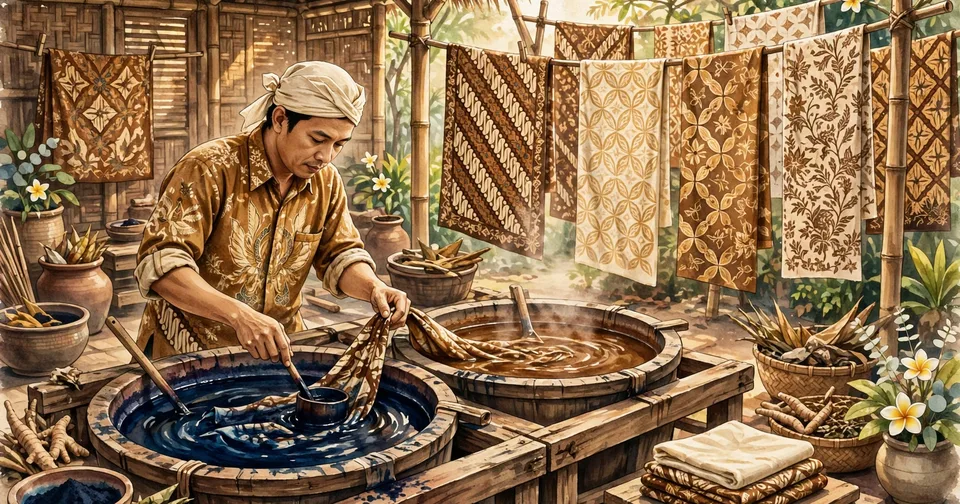
Quick summary: The stages of batik dyeing are a sequence of colouring processes applied to cloth whose pattern is partly protected by wax (malam), starting with colet and celup, followed by fixation, and finishing with lorod to remove the wax and reveal the motif.
A single piece of batik can hold three to four colours arranged neatly without ever mixing. The magic does not come from the dye, but from the way the artisan arranges the order of work: which parts are protected, which colour goes in first, and when the wax is removed. Understanding these stages helps us appreciate the precision behind every motif, and at the same time better understand how to care for the cloth.
1. Malam (Wax) as a Colour Resist
The key to the entire batik dyeing process is malam, a special wax that is melted and then drawn or stamped onto the cloth. The wax soaks into the fibres and works as a resist: the parts covered with wax will not absorb colour, while the uncovered parts will change according to the dye used. A batik motif is actually the "negative space" that will remain in the base colour of the cloth.
The quality of the wax and the accuracy of its temperature greatly determine the final result. Wax that is too hot will spread and blur the lines, while wax that is not hot enough will not penetrate the fibres, so colour leaks into areas that should have been protected. A complete discussion can be found in the article on getting to know the canting and batik wax. At Batik Isma, the stamped (cap) and hand-drawn (tulis) processes are done by hand using palm-based wax.
2. Colet Colouring with a Brush
Colet is a technique of applying colour locally using a brush. The artisan sweeps dye only onto certain areas of the motif, for example a red flower petal in the middle of a cloth whose base remains white or cream. This technique is economical with dye and allows many colours to sit side by side within a single motif.
The weakness of colet is that it demands a steady hand and just the right amount of water. Dye that is too runny will seep past the wax lines, while uneven strokes create blotches. Because it is done one area at a time, colet is used to highlight details and accents on the main motif.
3. Celup Dyeing for the Base Colour
Celup is the technique of immersing the entire cloth in a dye solution. This technique is used to give an even base colour, for example indigo blue or sogan brown. The parts already covered with wax will resist the dye, so the motif stays clean while the background of the cloth changes colour.
- The solution is prepared with consistent measurements and temperature so that the colour comes out even.
- The cloth is immersed for a certain duration, then aired so the colour begins to bind.
- For a deeper colour, the dipping can be repeated several times.
- The order generally starts from the lightest colour towards the darkest.
Arranging the order of colours is an art in itself: the artisan maps out from the very start the final colour of every area, because a light colour overlaid with a dark colour will change its character.
4. Tutup Celup for Layered Colours
For multi-coloured batik, the process is layered through the tutup celup technique. After the first colour is finished, the areas whose colour is to be preserved are covered again with wax, and then the cloth is dipped into the second colour. The areas that are still open change colour, while those that are covered keep their previous colour. This cycle is repeated until all the colours are achieved.
This is where precision is put to the test: a single area that is forgotten and left uncovered will change colour forever. The more layers of colour there are, the longer the work takes — one of the reasons genuine hand-drawn and stamped batik are valued differently from machine-printed patterned fabrics.
5. Fixation to Lock the Colour In
Colour that has adhered does not necessarily last if it is not locked in. Fixation is the stage of binding the dye so that it does not fade easily when the cloth is washed or worn. The method depends on the type of dye: some use special binding agents, while others rely on an oxidation process in the open air, such as indigo blue, which strengthens after the cloth is aired.
This stage is often invisible to buyers, yet it determines whether the colour stays bright for years or fades quickly. Patient fixation also reduces the amount of leftover dye that comes off in the first wash.
6. Lorod: Removing the Wax with Hot Water
After all the colours are finished and locked in, the cloth enters the lorod stage, which means boiling the cloth in hot water so that the wax melts and detaches from the fibres. This is where the motif appears in full: the lines and areas that had been protected all along emerge in their original colours, in contrast with the dyed background. The removed wax can be collected and used again.
For layered batik, some cloths are sometimes dewaxed and then drawn again for the next layer of motif. After the final lorod, the cloth is washed clean, dried in the shade, and is ready to be sewn into clothing or worn as a long cloth.
7. Natural and Synthetic Dyes
In general, batik dyes fall into two groups. Natural dyes come from plants and natural materials, such as indigo for blue, and certain tree barks and leaves for browns and creams; they produce distinctive soft colours but require a longer process. Synthetic dyes offer a far wider choice of colours, are more consistent, and work more quickly.
Neither is absolutely better; each is chosen according to the character of the motif and the needs of the wearer. A deeper explanation of the range of natural colour sources is available in the article on natural batik dyes. What matters most is that the artisan masters the fixation so that the colour adheres properly.
8. How Dyeing Affects Fabric Care
Understanding dyeing helps us care for batik properly. On the first wash, it is normal for the rinse water to be slightly coloured, because unbound leftover dye comes off; this diminishes with the following washes. Wash batik in cold water with a gentle soap or lerak (soapnut), keep it separate from other clothes, and avoid wringing it too hard.
Dry batik turned inside out in the shade, because direct sunlight accelerates colour fading, especially for natural colours. This simple care makes the artisan's long work pay off in a long lifespan for the cloth.
Discover Authentic Laweyan Batik at Batik Isma
The discussion above truly comes to life when you can see and feel the cloth in person. Batik Isma is located at Jl. Nitik No. 5, Kampoeng Batik Laweyan, Solo, in the heart of a neighborhood that has lived from the batik tradition for generations. Batik Isma makes hand-drawn batik (tulis), stamped batik (cap), and natural-dye batik, accepts batik uniform orders, and runs batik-making classes for anyone who wants to try it firsthand.
Batik Isma accepts batik uniform orders for offices, schools, communities, and families, with a choice of stamped (cap), hand-drawn (tulis), or natural-dye batik. Discuss your motif, fabric, quantity, and estimated production time directly via WhatsApp.
Whether you are looking for batik to wear yourself, to give as a gift, or to wear together with family and team, feel free to ask. Tell us what you need — the event you will attend, the colors you like, or the type of batik you are after — so we can suggest the most fitting options. Collection availability and other details can change at any time, so please ask us directly for the latest information.
Want to deepen your knowledge of batik? Read also our articles on getting to know the canting and batik wax and natural batik dyes. The better you know batik, the easier it is to choose a cloth that truly suits you and carries meaning.
Questions about the Batik Isma collection? Chat with Batik Isma on WhatsApp or visit the Catalog and Contact pages.
Frequently Asked Questions (FAQ)
What is the difference between colet and celup in batik dyeing?
Colet applies colour locally with a brush to certain areas of the motif, while celup immerses the whole cloth to colour the parts not covered by wax. The two are often combined in a single cloth.
What is the lorod process?
Lorod is the stage of boiling the cloth in hot water to melt and release the wax from the fibres. After lorod, the motif that had been protected by the wax appears in full with its final colours.
Why can batik colours be layered without mixing?
Because each colour is worked in stages through tutup celup: the areas whose colour is to be preserved are covered with wax before the cloth is dipped into the next colour.
Does batik always bleed colour the first time it is washed?
A little leftover colour in the first rinse water is normal, especially with natural dyes. After good fixation and a few gentle washes, the colour will stabilise and no longer come off easily.
Which lasts longer, natural or synthetic dye?
Both can last, as long as the fixation is right and the care is proper. Natural dyes tend to be more sensitive to sunlight and harsh soap, while synthetic dyes are generally more consistent and more resistant to washing.
Ask via WhatsApp