Quick summary: What are the canting and malam? Take a look at the types of canting, the wax mixtures, and their role in the quality of hand-drawn batik (batik tulis).
If batik is a painting, then the canting is its brush and the malam (wax) is its ink. These two simple tools are the heart of hand-drawn batik. The quality of the canting and the wax mixture greatly influences the neatness of the lines and the success of the dyeing process. Let us get to know the canting and the malam more closely.
What Is a Canting?
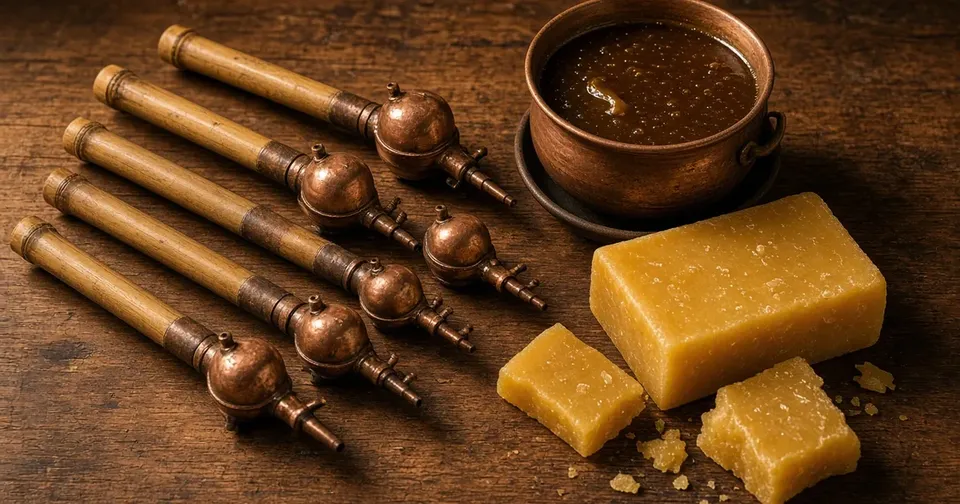
The canting is a tool for drawing molten wax onto cloth. Its form is simple, consisting of three parts:
- Nyamplung: a small copper reservoir that holds the molten wax.
- Cucuk: a small curved spout through which the wax flows out.
- Gagang: a handle made of bamboo or wood.
Copper is chosen because it conducts heat well, so the wax stays liquid longer while it is being drawn.
Types of Canting
By Function
- Canting reng-rengan: for drawing the main outline lines of the pattern (nglowong).
- Canting isen: for filling in details, or isen-isen, such as dots and fine lines.
- Canting tembokan: with a large spout, for covering wide areas.
By Number of Spouts
- Canting cecekan: one small spout for making dots.
- Canting loron: two spouts for double lines.
- Canting telon: three spouts forming a triangle of dots.
- Canting prapatan: four spouts.
- Canting liman: five spouts.
By Spout Size
There are canting with small, medium, and large spouts. A small spout produces fine lines; a large spout is for thick lines or areas.
What Is Malam?
Malam is the colour-resist material in batik. When wax covers part of the cloth, the dye cannot soak into that part. Malam is not ordinary candle wax, but a mixture of several ingredients blended to have the right flexibility, adhesiveness, and melting point.
The Ingredients of the Wax Mixture
The composition of malam can differ between artisans, but generally consists of:
- Gondorukem: pine resin that provides adhesiveness.
- Damar mata kucing: gives hardness and helps the wax not crack easily.
- Paraffin: makes the wax easier to remove.
- Beeswax, or kote: provides flexibility.
- Animal fat or coconut oil (kendal): helps flexibility and smoothness.
- Used wax (malam gladhagan): wax recovered from the lorod (dewaxing) process and used again.
Types of Wax by Function
- Malam klowong: for pattern lines; it must be flexible and adhesive.
- Malam tembok: thicker, for covering wide areas.
- Malam biron: for covering parts that are already blue before the next dyeing.
- Malam remukan: made to crack easily, producing a crackle effect.
Keeping the Wax at the Right Temperature
The wax is heated in a small pan over a small stove. The right temperature is very important:
- Too hot: the wax spreads and the lines widen.
- Too cold: the wax clogs the spout and does not soak into the cloth.
- Just right: the wax flows smoothly and penetrates the fibres of the cloth.
Experienced artisans can sense the right temperature simply from the flow of the wax and the sound it makes as it simmers gently.
How to Hold the Canting
The canting is held like a pencil, but tilted slightly. After taking wax from the pan, the spout is blown on gently so the wax does not drip, then drawn slowly following the pattern. The cloth on its frame (gawangan) is held with the other hand to keep it taut. Beginners usually practise making straight lines and dots before trying a motif.
Discover Authentic Laweyan Batik at Batik Isma
The discussion above truly comes to life when you can see and feel the cloth in person. Batik Isma is located at Jl. Nitik No. 5, Kampoeng Batik Laweyan, Solo, in the heart of a neighborhood that has lived from the batik tradition for generations. Batik Isma makes hand-drawn batik (tulis), stamped batik (cap), and natural-dye batik, accepts batik uniform orders, and runs batik-making classes for anyone who wants to try it firsthand.
Batik Isma accepts batik uniform orders for offices, schools, communities, and families, with a choice of stamped (cap), hand-drawn (tulis), or natural-dye batik. Discuss your motif, fabric, quantity, and estimated production time directly via WhatsApp.
Whether you are looking for batik to wear yourself, to give as a gift, or to wear together with family and team, feel free to ask. Tell us what you need — the event you will attend, the colors you like, or the type of batik you are after — so we can suggest the most fitting options. Collection availability and other details can change at any time, so please ask us directly for the latest information.
Questions about the Batik Isma collection? Chat with Batik Isma on WhatsApp or visit the Catalog and Contact pages.
Frequently Asked Questions (FAQ)
What is a canting made of?
The reservoir and spout of a canting are generally made of copper, with a bamboo or wooden handle.
What is the difference between malam and ordinary candle wax?
Malam is a mixture of several ingredients such as gondorukem, damar resin, paraffin, and fat, making it more flexible and adhesive than ordinary wax.
What is a canting cecekan?
A canting with one small spout for making dots on a motif.
Can wax be reused?
Yes. Wax that comes off during lorod (dewaxing) can be collected and mixed again.
Can a canting be made by oneself?
Canting are generally made by specialist artisans because the copper spout must be precise. For practice, beginners can simply use a standard canting, widely available in batik centres such as Laweyan.
Why do my wax lines spread when I use the canting?
Usually because the wax is too hot or the canting stays on the cloth too long. Lower the flame, blow on the spout before drawing, and move the canting at a steady speed.
Ask via WhatsApp