Quick summary: The process of making hand-drawn batik (batik tulis) begins with drawing the pattern in pencil on the cloth, then drawing the main outlines with the canting (klowong), filling in the details (isen-isen), wax-covering (nembok), dyeing, and removing the wax (lorod) — a sequence repeated for every color until the cloth is finished.
Among all batik techniques, batik tulis is the most personal: every line is drawn directly by the artisan's hand with a canting. No two pieces of batik tulis are ever exactly alike, even when their motifs are similar. To understand why a single piece of batik tulis takes days to weeks of work, let us go through its stages one by one.
1. Preparing the Cloth and Drawing the Pattern (Molani)
The process starts with mori cloth — generally fine primisima cotton — which is washed and lightly starched so its surface is even and the wax (malam) can adhere well. Once dry and ironed, the artisan draws the motif pattern directly onto the cloth with a pencil. This stage is called molani. Experienced artisans often draw freehand without a sample, relying on memory and their feel for both classic motifs and new creations. This pencil pattern becomes the map for all the stages that follow.
2. Drawing the Main Outlines with the Canting (Klowong)
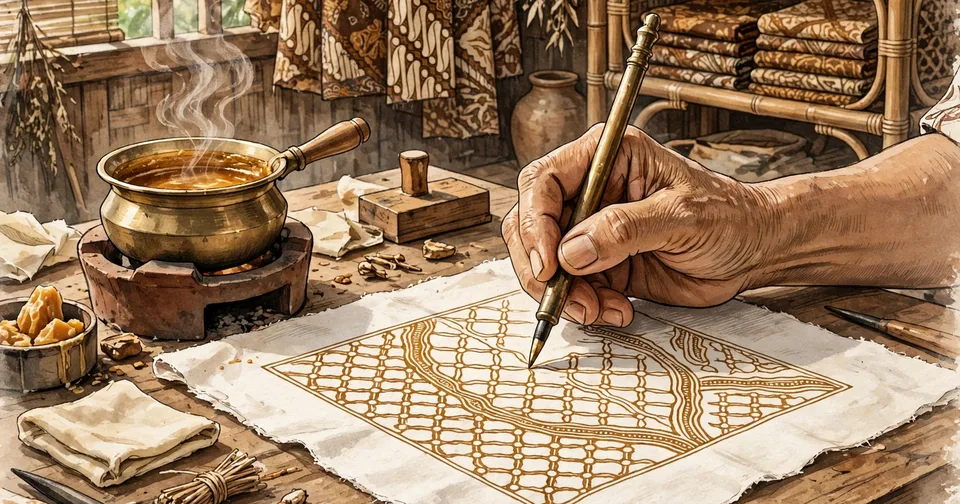
Next the cloth is stretched on a wooden frame (gawangan), and the artisan begins applying the canting along the pattern lines with heated liquid wax — at Batik Isma, the wax used is palm-based. Drawing the main lines of the motif is called klowong or nglowong. The canting is moved slowly, keeping the line thickness consistent; the wax must be hot enough to soak into the cloth fibers, but not so hot that it spreads. More about the canting and wax can be read in the article getting to know the canting and malam in batik.
3. Filling in the Details (Isen-Isen)
Once the framework of the motif has taken shape, the artisan fills the inside of the motif with small ornaments: dots, short lines, scales, or fine curves. This stage is called isen-isen and is done with a smaller-tipped canting. Isen-isen is where the artisan's freedom takes the stage — this is where a person's hand shows its character, and this is where two pieces of batik with the same motif can feel different. It is also the stage that takes the most time and demands the highest concentration.
For experienced batik makers, isen-isen is often done without looking at any sample at all, flowing with the rhythm of the hand. One flower motif area, for example, might be filled with a combination of cecek (dots), sawat (curved lines like wings), and sisik melin (scale patterns), each chosen spontaneously. That is why recognizing the isen style is one way to recognize the hand of the batik maker behind a piece of cloth, much like recognizing someone's handwriting.
4. Covering the Areas to Be Protected (Nembok)
Before dyeing, the parts of the cloth whose color is to be preserved are covered with wax using a large canting or a brush. This stage is called nembok. The wax layer at the nembok stage is made thicker and more even, because its function is that of a shield: holding the dye back from the protected areas. Fine cracks in the wax layer are sometimes made deliberately to produce the crackle effect characteristic of traditional batik.
5. Dyeing: Dip Dyeing and Colet
The cloth is then dyed. The most common method is immersion: the cloth is dipped into a dye bath, lifted out and aired, then dipped repeatedly until the color reaches the desired depth. For small areas of color on motif details, artisans use the colet technique — brushing the dye directly onto parts of the motif with a brush. Dyes can come from natural materials such as indigo, sogan, and mengkudu (Indian mulberry), or from synthetic dyes, which offer a wider range of colors and a faster process.
6. Lorod and Repeating for the Next Color
After dyeing is complete and the color has been fixed (fixation), the wax is removed through lorod: the cloth is boiled in hot water until the wax melts and lifts away. The cloth is then washed and dried. If the design requires a second and third color, the whole sequence — nembok, dyeing, lorod — is repeated again for each color. This is why multi-colored batik tulis takes so long: every color is one full round of work.
The wax left over from lorod is not actually wasted. In many traditional batik workshops, the wax floating on the boiling water is collected, filtered, and melted down again for use in the next process. This kind of thrifty material management has been practiced in batik villages for a long time, long before the term recycling became widely known.
7. Finishing, and the Cloth Is Ready to Wear
The final stage is finishing: the cloth is washed clean of remaining wax and dye, dried in a shaded place, then ironed and quality-checked — lines, colors, and the neatness of the motif are examined one by one. After passing inspection, the batik tulis cloth is ready to be sewn into a shirt, a dress, or worn as a kain panjang (long cloth). At Batik Isma, Jl. Nitik No. 5, Kampoeng Batik Laweyan, Solo, batik tulis is handmade in this way, in line with the tagline "The Elegance of Tradition, the Style of Today".
8. Why Batik Tulis Takes Long and Is Always Unique
All of the stages above are done by hand, one piece of cloth at a time, and many colors mean many repetitions. This differs from stamped batik (batik cap), whose motifs are stamped with a copper stamp so the work is faster and more uniform — the comparison is laid out in the article on the process of making batik cap — batik tulis carries the trace of its maker's hand: lines that tremble slightly, isen that is never exactly the same, and color nuances from repeated dipping. Those small imperfections are precisely what make every piece of batik tulis one of a kind.
Discover Authentic Laweyan Batik at Batik Isma
The discussion above truly comes to life when you can see and feel the cloth in person. Batik Isma is located at Jl. Nitik No. 5, Kampoeng Batik Laweyan, Solo, in the heart of a neighborhood that has lived from the batik tradition for generations. Batik Isma makes hand-drawn batik (tulis), stamped batik (cap), and natural-dye batik, accepts batik uniform orders, and runs batik-making classes for anyone who wants to try it firsthand.
Batik Isma accepts batik uniform orders for offices, schools, communities, and families, with a choice of stamped (cap), hand-drawn (tulis), or natural-dye batik. Discuss your motif, fabric, quantity, and estimated production time directly via WhatsApp.
Whether you are looking for batik to wear yourself, to give as a gift, or to wear together with family and team, feel free to ask. Tell us what you need — the event you will attend, the colors you like, or the type of batik you are after — so we can suggest the most fitting options. Collection availability and other details can change at any time, so please ask us directly for the latest information.
Want to deepen your knowledge of batik? Read also our articles on getting to know the canting and malam in batik and the process of making batik cap. The better you know batik, the easier it is to choose a cloth that truly suits you and carries meaning.
Questions about the Batik Isma collection? Chat with Batik Isma on WhatsApp or visit the Catalog and Contact pages.
Frequently Asked Questions (FAQ)
How long does it take to make one piece of batik tulis?
It depends on the complexity of the motif and the number of colors — from several days for a simple motif to weeks, even months, for a fine multi-colored motif. Every color adds one full round of nembok, dyeing, and lorod.
What is the difference between klowong and isen-isen?
Klowong is drawing the main lines or framework of the motif with the canting. Isen-isen is filling the inside of the motif with small ornaments such as dots and short lines using a smaller canting.
What is the lorod process in batik making?
Lorod is removing the wax from the cloth by boiling it in hot water after dyeing is finished. The melted wax lifts away from the cloth, revealing the motif and colors it had been protecting all along.
Why are no two pieces of batik tulis exactly alike?
Because every line is drawn directly by the artisan's hand without a mold. Small differences in lines, motif filling, and dyeing results always appear, so every piece is unique.
Does batik tulis always use natural dyes?
Not always. Batik tulis can use natural dyes such as indigo and sogan, as well as synthetic dyes, depending on regional tradition and color needs. It is the canting technique that determines the name batik tulis.
Ask via WhatsApp