
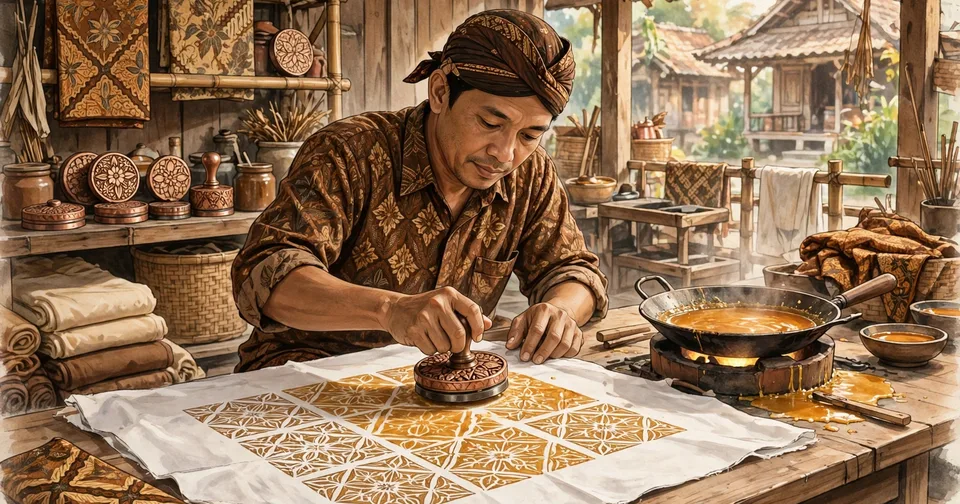
Quick summary: The batik cap process is a sequence of batik-making stages using a copper stamp: the motif is designed, the copper stamp is made, the mori cloth is prepared, then the stamp is dipped into hot wax and pressed repeatedly onto the cloth before the cloth is dyed, dewaxed (lorod), washed, dried, and checked for quality.
Batik cap is often regarded as the quick version of batik tulis (hand-drawn batik), yet both are equally handcrafted work that demands precision. The difference lies in the tool: batik tulis uses a canting, while batik cap uses a copper stamp (cap), so its motifs look neat and repeat in a consistent pattern. This article walks through every stage until the cloth is ready to be sewn.
1. Motif Design: Everything Starts with a Drawing
The first stage is designing the motif. The artisan draws the pattern on paper, taking into account the size of the stamp, the spacing between motifs, and the direction of the repeats across the cloth. A good motif must read clearly when it is repeated dozens of times: firm lines, details that are not too small, and a balanced composition.
The design also determines the character of the cloth: a dense geometric motif gives a formal impression, while a sparse floral motif feels lighter. Once a copper stamp has been made, that motif will be used for a long time to come.
2. Making the Copper Stamp by Specialist Artisans
The copper stamp is made by specialist metal artisans. Copper plates are cut following the lines of the design, then arranged upright, shaped to the pattern, and soldered together until they form a single solid stamp, complete with a handle on its back.
This work can take days and demands a high level of precision, because a small flaw on the stamp will be repeated across the entire cloth. That is why copper stamps are carefully looked after and kept for years, producing many lengths of cloth.
3. Preparing the Mori Cloth
Before it is stamped, the mori (cotton) cloth is prepared so that the wax and colour adhere perfectly. The cloth is washed or soaked to remove dirt and weaving residues, then dried and spread out flat over a padded stamping table. Some artisans also apply a light starch (kanji) treatment, depending on the habits of their workshop.
Clean, flat cloth makes for sharp stamping results. If the cloth is wrinkled or dirty, the wax will not adhere evenly and the lines of the motif can come out broken.
4. Stamping with Hot Wax
This is the heart of the batik cap process. The wax (malam) is heated in a flat pan until it melts. The copper stamp is dipped briefly into the surface of the wax, drained, and then pressed firmly and evenly onto the cloth. A soft hiss and the aroma of hot wax are the hallmarks of a batik workshop while stamping is under way.
The artisan repeats that press row by row until the whole cloth is covered with the motif, with positioning that must be precise so the joins between motifs do not shift. To learn more about this colour-resist material, read our article on getting to know the canting and batik wax (malam). At Batik Isma, the wax used is palm-based, and the stamping is done by hand by artisans in Laweyan, Solo.
5. Dyeing: Giving the Cloth Its Colour
Once the wax has dried, the cloth is dyed. The parts covered by wax do not absorb the colour, while the open parts change to follow the colour of the dye bath. Dyeing can be done once, or repeated for a richer combination of colours.
For multi-coloured motifs, part of the motif is covered again with wax after the first dyeing, and the cloth is then dipped into the next colour. Each layer adds depth of colour, but also time and risk, so the sequence of colours is worked out from the lightest to the darkest so that the result does not turn muddy.
6. Lorod: Removing the Wax from the Cloth
Lorod is the stage of removing the wax by boiling the cloth in hot water. The wax melts and lifts away from the fibres of the cloth, and the motif that was covered from the very start appears in its original colour. This moment is called the moment of truth, because it is here that the actual result is seen in full for the first time.
The boiling water is sometimes given additional ingredients so the wax comes off easily and does not stick back on. The leftover wax can be filtered and used again.
7. Washing, Drying, and Quality Control
Cloth that has been dewaxed is washed clean to remove wax residue and excess colour, then hung out to dry, generally avoiding overly harsh direct sunlight so the colours do not fade quickly.
Finally, every length passes through quality control: the neatness of the motif, the stamp joins, and the evenness of the colour are examined one by one. Flawed cloth is set aside, so that only cloth fit for use goes on to be sewn or sold by the piece.
8. Why Batik Cap Suits Repeating Motifs and Uniforms
The main advantage of batik cap is consistency. Because it uses one and the same stamp, the motif repeats with uniform size and spacing across the whole cloth. For needs such as the following, this character is a great help:
- Office, school, or community uniforms that need many cuts of cloth with the same motif.
- Outfits for couples or families who want to appear coordinated with identical motifs.
- Producing cloth in larger quantities in a shorter time than batik tulis.
The more efficient working time also makes batik cap generally more affordable than batik tulis, without abandoning the handmade process — the stamping, dyeing, and lorod are still carried out by hand, not by a printing machine.
9. The Different Feel of Cap vs Tulis Results
Batik cap feels neat, firm, and orderly — suited to those who like a clean and symmetrical look. Batik tulis feels more personal: its lines flow following the artisan's hand, and every length has subtle differences that cannot be copied exactly. The two are a matter of taste and need, not a question of which one is more genuine.
The easiest way to tell them apart is to look at the repetition of the motif and at both sides of the cloth, as set out in the article on how to tell apart and care for batik tulis, cap, and printing. Batik Isma at Jl. Nitik No. 5, Kampoeng Batik Laweyan, Solo — point No. 42 on the Laweyan Tourist Map — works in handmade cap and tulis techniques with the tagline “Elegansi Tradisi, Gaya Masa Kini”.
Discover Authentic Laweyan Batik at Batik Isma
The discussion above truly comes to life when you can see and feel the cloth in person. Batik Isma is located at Jl. Nitik No. 5, Kampoeng Batik Laweyan, Solo, in the heart of a neighborhood that has lived from the batik tradition for generations. Batik Isma makes hand-drawn batik (tulis), stamped batik (cap), and natural-dye batik, accepts batik uniform orders, and runs batik-making classes for anyone who wants to try it firsthand.
Batik Isma accepts batik uniform orders for offices, schools, communities, and families, with a choice of stamped (cap), hand-drawn (tulis), or natural-dye batik. Discuss your motif, fabric, quantity, and estimated production time directly via WhatsApp.
Whether you are looking for batik to wear yourself, to give as a gift, or to wear together with family and team, feel free to ask. Tell us what you need — the event you will attend, the colors you like, or the type of batik you are after — so we can suggest the most fitting options. Collection availability and other details can change at any time, so please ask us directly for the latest information.
Want to deepen your knowledge of batik? Read also our articles on getting to know the canting and batik wax (malam) and how to tell apart and care for batik tulis, cap, and printing. The better you know batik, the easier it is to choose a cloth that truly suits you and carries meaning.
Questions about the Batik Isma collection? Chat with Batik Isma on WhatsApp or visit the Catalog and Contact pages.
Frequently Asked Questions (FAQ)
Is batik cap considered genuine batik?
Yes. Batik cap is made through a genuine batik process using hot wax as a colour resist; only the tool is a copper stamp, not a canting. What is not batik in the process sense is printed cloth with batik motifs, because its colours are printed without wax.
How long does the batik cap making process take?
For a single length of cloth, the process generally runs for several days, depending on the number of colours and the complexity of the motif. Making the copper stamp also takes days, but that stamp is used repeatedly for many lengths of cloth.
Why can batik cap motifs look exactly alike from cloth to cloth?
Because all the cloth is stamped with the same copper stamp, the size and shape of the motifs are consistent. Small differences can still appear from hand pressure and dyeing, but the appearance is far more uniform than batik tulis.
Can batik cap be washed in a washing machine?
It is best washed by hand using cold water and a gentle soap so the colours last. A washing machine with a hard spin can damage the fibres and speed up fading, especially on the first wash.
Where can I see Batik Isma's batik cap collection?
Batik Isma's catalogue, photos, and price information can be asked directly via the official WhatsApp listed on this site, so that buyers receive the latest collection information straight from the Batik Isma team.
Ask via WhatsApp