Quick summary: Lurik is a traditional Javanese woven cloth with a striped motif, made on a loom rather than with batik techniques, and it looks harmonious when paired with batik in a single outfit or uniform.
Among Indonesia's traditional cloths, lurik is often mentioned together with batik, even though the two are made in very different ways. Lurik is recognized by its neat stripes and generally calm colors, while batik is recognized by motifs drawn or stamped with wax (malam). Both were born from Javanese culture and both are still worn today, from daily clothing to office uniforms. This article invites you to get to know lurik more closely: what lurik is, where it comes from, how it differs from batik and ikat weaving, and how to pair it with batik so your appearance looks harmonious.
1. What Is Lurik Cloth
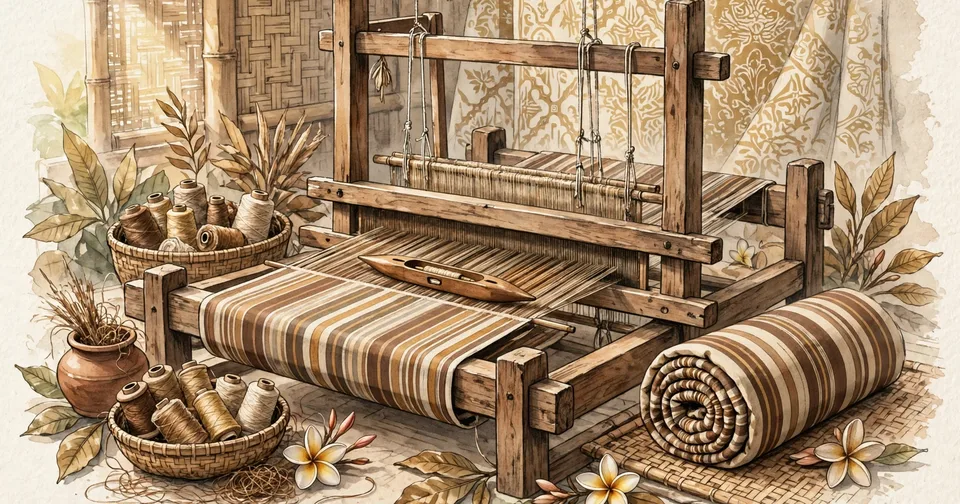
Lurik is cloth woven from threads that have been dyed beforehand, then arranged to form a lengthwise stripe pattern. The name lurik comes from a Javanese word related to lines or stripes, matching its main characteristic. Because the motif is formed by the arrangement of threads during weaving, the stripes on lurik appear equally clear on both sides of the cloth. The tool used can be a non-machine loom (alat tenun bukan mesin) worked by the weaver's hands and feet. The result is a cloth with visible fibers and a texture you can feel, different from plain factory-made cloth. Lurik is generally made from cotton thread, so it is comfortable to wear in a tropical climate. The tighter the thread arrangement, the finer and neater the woven result, and the more comfortable the cloth is to wear.
2. Origins and Traditional Use in Java
Lurik has long been known in Java, including in the regions of Yogyakarta, Solo, and Klaten, which are centers of traditional weaving. In the past, lurik was worn as everyday clothing by the people, as surjan fabric for men, and as kebaya and jarik for women. This cloth also appeared in various traditional ceremonies as part of customary dress. The simplicity of its striped motif made lurik accepted by all circles, from common people to the palace (keraton) environment. To this day, traditional weavers still maintain the manual way of making it, and lurik continues to be produced as cloth, ready-to-wear clothing, and craft material. Its enduring existence shows that lurik is not merely a cloth, but part of the daily life of Javanese society.
3. The Difference Between Lurik, Batik, and Ikat Weaving
The difference between the three lies in how the motif is made. In lurik, the stripe motif is formed during the weaving process because the warp threads are already colored. In batik, the motif is made on finished cloth by drawing or stamping wax (malam) as a dye resist, then the cloth is dyed; Batik Isma in Kampoeng Batik Laweyan, Solo, for example, makes handmade stamped (cap) and hand-drawn (tulis) batik with palm-based wax. In ikat weaving, meanwhile, the threads are tied and dyed first following a certain pattern before being woven, so the motif appears as the cloth takes shape. In short: lurik plays with lines from the thread arrangement, batik plays with pictures on the cloth's surface, and ikat plays with patterns on the thread itself.
4. Pairing Lurik and Batik in One Outfit
Lurik and batik are easy to pair because lurik's simple stripes balance batik's busier motifs. The safe formula: make one cloth the main star and the other an accent. For example, a batik shirt paired with plain tailored trousers and a lurik scarf, or a lurik blouse paired with a batik skirt. For family or office uniforms, lurik can be used as the top material and batik as the bottom, or the reverse, with the same color palette. Also pay attention to the direction of the stripes and the size of the motifs so they do not clash. Inspiration for suitable batik motifs can be learned through our article on Solo batik motifs and their meanings before deciding on the cloth pairing.
5. Modern Lurik: From Shirts to Bags
Today lurik is no longer limited to traditional dress. Many artisans and local labels turn it into casual shirts, outer layers, light blazers, dresses, skirts, and even bags, wallets, and cloth shoes. Its clean stripes make lurik easy to fit into modern styles, looking neat for work as well as casual events. Lurik is also often chosen as a uniform material because its motif is not busy and suits various ages. If you plan to sew your own, the principles for choosing and calculating the cloth are similar to batik cloth; the guide can be read in our article on batik cloth for sewing. With the right treatment, modern lurik still carries a traditional nuance without feeling old-fashioned. Lurik cloth is also widely used for souvenirs and interior complements, such as tablecloths, cushion covers, and book covers, because its stripe pattern is easy to match with contemporary room styles.
6. How to Care for Lurik Cloth
As a woven cloth, lurik needs gentle care so its fibers and colors last. Wash by hand using cold water and mild soap, separated from strongly colored clothing, especially on the first wash. Avoid wringing too hard; simply press the cloth and air it out. Dry it in the shade so the stripe colors do not fade quickly under direct sunlight. Iron at medium heat from the inside of the cloth. Store it clean and dry, away from damp places. For cotton lurik, this care is quite simple and requires no special treatment like silk cloth. With proper care, woven lurik can last for years and stay comfortable to wear.
Discover Authentic Laweyan Batik at Batik Isma
The discussion above truly comes to life when you can see and feel the cloth in person. Batik Isma is located at Jl. Nitik No. 5, Kampoeng Batik Laweyan, Solo, in the heart of a neighborhood that has lived from the batik tradition for generations. Batik Isma makes hand-drawn batik (tulis), stamped batik (cap), and natural-dye batik, accepts batik uniform orders, and runs batik-making classes for anyone who wants to try it firsthand.
Batik Isma accepts batik uniform orders for offices, schools, communities, and families, with a choice of stamped (cap), hand-drawn (tulis), or natural-dye batik. Discuss your motif, fabric, quantity, and estimated production time directly via WhatsApp.
Whether you are looking for batik to wear yourself, to give as a gift, or to wear together with family and team, feel free to ask. Tell us what you need — the event you will attend, the colors you like, or the type of batik you are after — so we can suggest the most fitting options. Collection availability and other details can change at any time, so please ask us directly for the latest information.
Want to deepen your knowledge of batik? Read also our articles on Solo batik motifs and their meanings and batik cloth for sewing. The better you know batik, the easier it is to choose a cloth that truly suits you and carries meaning.
Questions about the Batik Isma collection? Chat with Batik Isma on WhatsApp or visit the Catalog and Contact pages.
Frequently Asked Questions (FAQ)
Is lurik a type of batik?
No. Lurik is a woven cloth whose stripe motif is formed from the arrangement of colored threads as it is woven, while batik is made with wax (malam) on finished cloth. Both are traditional Javanese cloths, but their making techniques differ.
What is the difference between lurik and ikat weaving?
In lurik, threads are dyed and then woven to form simple stripes. In ikat weaving, the threads are tied and dyed following a specific motif pattern before being woven, so the motif is more complex and emerges from the thread-tying pattern.
Is lurik suitable for uniforms?
Yes. Its unobtrusive stripe motif makes lurik look neat for office, school, and family uniforms, and it is easy to pair with batik as a bottom or an accent.
How do you wash lurik cloth?
Wash by hand using cold water and mild soap, separate it from other clothing on the first wash, then dry it in the shade. Avoid wringing too hard so the woven fibers are not damaged.
Can lurik be paired with batik?
Yes, and the combination is actually harmonious. Make one cloth the main star and the other an accent, keep the same color palette, and pay attention to motif size so the appearance stays balanced.
Ask via WhatsApp