Quick summary: Batik fabric for sewing is best chosen to suit the garment model, with the amount needed calculated from the type of garment, body size, and cloth width — unsewn batik cloth commonly sold in 2–2.5 metre lengths is enough for one shirt or blouse.
Many batik lovers across Indonesia choose to buy unsewn cloth rather than finished clothing. The reason is simple: the cloth can be sewn into any model with measurements that truly follow the wearer's body. But buying cloth also raises new questions — how many metres do you need, which fabric suits it, and how do you convey your wishes to a tailor? This guide answers them one by one, so your chosen batik cloth becomes neat, comfortable clothing instead of just a keepsake in the wardrobe.
1. The Advantages of Buying Unsewn Batik Cloth
The first advantage is freedom of model. The same piece of cloth can become a shirt, blouse, dress, skirt, or outer, according to your needs and style. Even a favourite motif that is not available as finished clothing can still be yours in garment form.
The second advantage is accuracy of size. Sewn clothing follows the measurements of the person who ordered it, so it also suits those who often struggle to find the right fit in ready-made products — for example, people who are very tall or petite. Third, you can control the details: sleeve length, collar shape, button placement, right down to the pockets. Finally, unsewn cloth is easy to store and to give as a gift, because the recipient is free to decide on their own model.
2. Calculating Fabric Needs for Each Garment
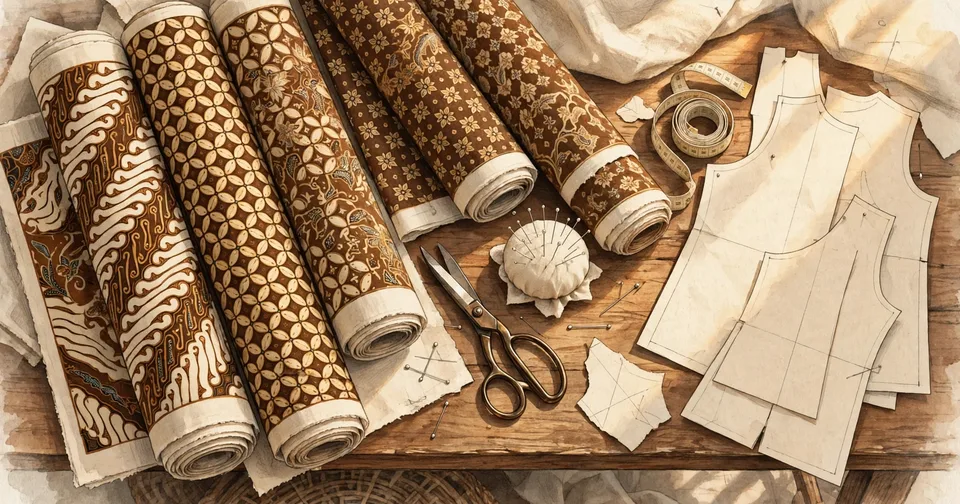
Fabric needs are influenced by three things: the type of garment, body size, and cloth width. Unsewn batik cloth is generally sold per piece of 2 to 2.5 metres long with a width of about 1 to 1.15 metres. As a general estimate for a medium body size and that cloth width:
- Short-sleeved shirt: about 1.5–1.75 metres.
- Long-sleeved shirt: about 1.75–2 metres.
- Women's blouse: about 1.25–1.5 metres.
- Knee-length skirt: about 1–1.25 metres; a long skirt can take 1.5–2 metres.
- Knee-length dress: about 2–2.5 metres.
- Long dress or gamis (long Muslim dress): about 2.75–3.25 metres.
The figures above are a general guide, not an absolute standard. A large body size, layered models, balloon sleeves, or motifs that must be aligned will increase the need. Because unsewn batik cloth is sold per piece, one piece of 2–2.5 metres is generally safe for one shirt or blouse; for a long dress, prepare two pieces or confirm with your tailor first before buying.
3. Cloth Width and Motif Direction When Cutting
Cloth width determines how efficiently the pattern pieces can be laid out. On narrow cloth, the body and sleeve patterns may have to be arranged lengthwise, so more cloth is used. That is why you should always tell your tailor the width of the cloth you bought when consulting them.
Motif direction is no less important. Many batik motifs have a top–bottom orientation; an upside-down motif will look odd when worn. Diagonal motifs such as parang flow following their cutting direction, while large motifs meant to be displayed whole on the chest or back need special placement and more generous cloth. Some cloth also has a specially patterned border section, often used for the hem of a skirt or dress. All of this should be discussed before the cloth is cut, because once cut there is no way back.
4. Choosing Fabric to Match the Garment
The fabric determines the drape and comfort of the clothing. Cotton is the most common choice for everyday shirts and dresses because it absorbs sweat and is easy to sew. Finer, denser primisima cotton suits occasion wear that looks neater. Textured fabrics such as dobby give an elegant raised impression for men's shirts, while softer, flowing fabrics suit loose dresses and women's blouses.
Also pay attention to the batik technique. Hand-drawn (tulis) and stamped (cap) batik cloth made by hand — such as that made by Batik Isma in Kampoeng Batik Laweyan, Solo, using palm-based wax (malam) — has a lively motif character and suits being made into a special main garment. To learn the differences between the techniques and how to care for them, please read our article on how to tell apart and care for hand-drawn, stamped, and printed batik.
5. Wash First Before Sewing: The Shrinkage Question
New cotton cloth can shrink slightly in the first wash. If the cloth is sewn straight away without washing, clothing that initially fits can feel narrower after its first wash at home. That is why many tailors advise washing or soaking the cloth first before cutting it.
The method is simple: soak the cloth separately from other clothing in clean water, dry it in the shade without wringing it hard, then iron it before taking it to the tailor. The first soaking also releases leftover wax (malam) and excess dye from the batik-making process, so the cloth being sewn is in its true colour. Also ask about your tailor's habits — some tailors already factor shrinkage into their patterns.
6. Communicating with Your Tailor So the Result Matches
A good sewing result is largely determined by communication at the start. Convey the model you want as clearly as possible — example photos help a lot — along with your latest body measurements, not old ones. Also explain details that are often forgotten: garment length, collar shape, pocket position, and whether a particular motif should be highlighted at the front.
Ask from the start about the tailor's estimate of fabric needs, the cost and working time, and whether leftover cloth will be returned. Leftover pieces of batik cloth are still useful for accessories, masks, or later repairs. If buying cloth online, you can also ask the seller for photos and fabric descriptions first; Batik Isma at Jl. Nitik No. 5, Kampoeng Batik Laweyan, Solo, answers catalogue and fabric questions via WhatsApp before purchase.
Discover Authentic Laweyan Batik at Batik Isma
The discussion above truly comes to life when you can see and feel the cloth in person. Batik Isma is located at Jl. Nitik No. 5, Kampoeng Batik Laweyan, Solo, in the heart of a neighborhood that has lived from the batik tradition for generations. Batik Isma makes hand-drawn batik (tulis), stamped batik (cap), and natural-dye batik, accepts batik uniform orders, and runs batik-making classes for anyone who wants to try it firsthand.
Batik Isma accepts batik uniform orders for offices, schools, communities, and families, with a choice of stamped (cap), hand-drawn (tulis), or natural-dye batik. Discuss your motif, fabric, quantity, and estimated production time directly via WhatsApp.
Whether you are looking for batik to wear yourself, to give as a gift, or to wear together with family and team, feel free to ask. Tell us what you need — the event you will attend, the colors you like, or the type of batik you are after — so we can suggest the most fitting options. Collection availability and other details can change at any time, so please ask us directly for the latest information.
Want to deepen your knowledge of batik? Read also our articles on how to tell apart and care for hand-drawn, stamped, and printed batik. The better you know batik, the easier it is to choose a cloth that truly suits you and carries meaning.
Questions about the Batik Isma collection? Chat with Batik Isma on WhatsApp or visit the Catalog and Contact pages.
Frequently Asked Questions (FAQ)
What can one 2-metre piece of batik cloth become?
Generally enough for one men's shirt with short or long sleeves, one women's blouse, or a skirt. For a dress, one piece is usually enough up to knee length, depending on body size and cloth width.
Does batik cloth have to be washed before sewing?
It is recommended, especially for cotton cloth, because the cloth can shrink slightly in the first wash. Soaking the cloth before cutting makes the garment's size more stable and its colour the true colour.
Is it better to buy the cloth first or ask the tailor first?
The safest is to ask the tailor first about fabric needs for your model and size, then buy the cloth. If the cloth has already been bought, bring it along to the consultation so the tailor can check its sufficiency directly.
Why do large motifs need more cloth?
Because the tailor needs to select parts of the cloth so the motif appears whole and aligned where you want it, for example on the chest of a shirt. Choosing these positions leaves some cloth unused, so extra allowance is needed.
Is hand-drawn batik cloth suitable for sewing into clothing?
Yes. Hand-drawn (tulis) and stamped (cap) batik cloth on quality cotton is in fact often chosen for special shirts and dresses because its motifs are distinctive and not commonplace. Just make sure the tailor is experienced in handling batik cloth so the motif direction is right.
Ask via WhatsApp