
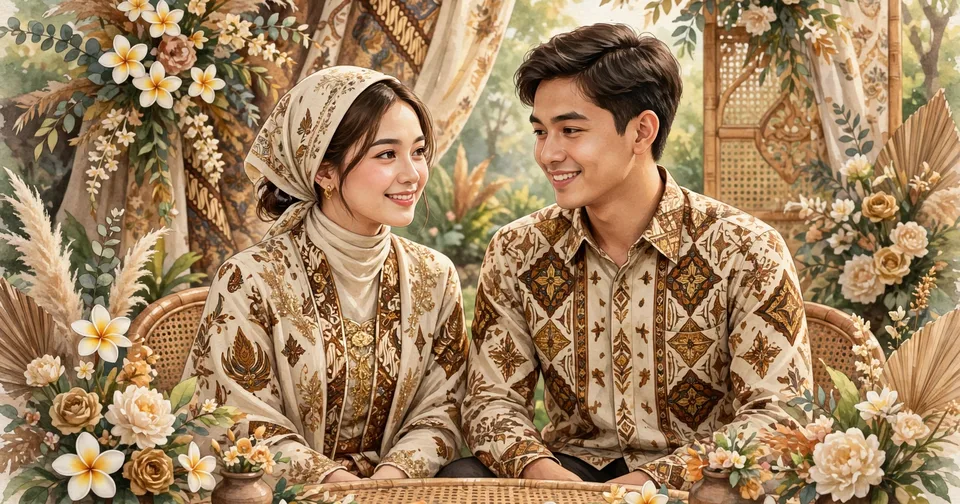
Quick summary: Couple batik for an engagement looks sweetest when the partners wear one motif family or one shared color palette — it does not have to come from exactly the same cloth. The keys are color harmony, motifs that do not clash, and outfits ordered well in advance so there is time to try them on and have them adjusted.
An engagement (lamaran) is the moment when two families meet formally for the first time, so the couple's appearance naturally draws attention. Many couples in Indonesia choose couple batik for this special day because it conveys politeness, cultural roots, and warmth in front of future in-laws. Compared with uniform outfits made from exactly the same single cloth, the modern couple concept is far more flexible and safer for various body shapes. This article guides you in choosing motifs, colors, and companions so you look coordinated without seeming overdone.
1. The Modern Couple Concept: One Motif Family, One Color Palette
Today's couple batik no longer demands identical cuts of cloth for the man and the woman. The preferred concept is one motif family — for example, both wearing a parang motif at different scales — or simply one color palette, such as cream and sogan brown, while the motifs may differ. This approach keeps the couple visibly connected within one photo frame, while each person can still choose the motif that best suits their taste and build.
2. Choosing Colors That Are Safe for Photos and the Extended Family
An engagement ceremony is almost always photographed, so choose camera-friendly colors. Earthy colors such as sogan brown, cream, soft terracotta, and indigo blue tend to look elegant on various skin tones and are not easily washed out by indoor lighting. Avoid neon or overly striking colors that can overpower faces in photos, and avoid very busy motifs on both partners, because the camera will capture them as a noisy pattern. One partner may wear a dominant motif, while the other keeps to a calmer motif in a matching tone.
3. Harmonizing with a Kebaya or Your Partner's Outfit
At many engagements, the bride-to-be wears a kebaya with a batik cloth as the lower garment, while the groom-to-be wears a batik shirt. Harmony is easiest to achieve when the kebaya's lower cloth and the man's shirt share the same color palette or basic motif. If the kebaya is light in color, the man's shirt can take a deeper derivative shade from the same color family so they do not appear to compete. This kind of pairing also aligns with the family-togetherness concept discussed in our guide to family sarimbit batik, which emphasizes unity of atmosphere without requiring complete uniformity.
4. The Role of Accompanying Family Members
An engagement involves the extended families of both sides, and the companions' appearance helps determine the harmony of the atmosphere. The immediate family usually only needs to wear batik in colors still within the same family as the couple's, while the motifs and styles can be free and simpler. Avoid making the whole entourage wear exactly the same motif like a corporate event uniform, because an engagement is an intimate family gathering, not a company's formal occasion. Just agree on a color range from the start so that group photos come out neat rather than random.
5. Choose Silhouettes That Suit Your Body Shape
Coordination must not sacrifice comfort and confidence. For men, a long-sleeved batik shirt with a well-fitting cut — neither tight nor baggy — gives the most polite impression when facing the partner's family. For women, pay attention to motif scale: large motifs suit long cloth (kain panjang) and dresses, while small, dense motifs are safe for blouses and tops. If you are buying cloth to be sewn, discuss the motif direction with the tailor first so the main motif lands in a good position on the body.
6. Order Well in Advance and Leave Time for Fittings
The most common mistake is preparing the outfits too close to the day of the event. Ideally, couple batik for an engagement should start being prepared several weeks beforehand, especially if you choose cloth that still needs sewing or are ordering quantities for accompanying family members. Leave time for fittings and small fixes such as narrowing sleeves or adjusting length. Even for ready-to-wear choices, buying early gives room to exchange sizes or styles if they turn out not to suit after trying them on at home.
7. Things Best Avoided
There are several common mistakes that make couple batik look less successful. First, forcing identical motifs on cloth of different quality and color, so the pair actually looks disjointed. Second, choosing motifs that are too large and busy for both partners until they overpower facial expressions in photos. Third, mixing too many techniques — for example, one partner wearing fine hand-drawn batik (tulis) and the other a highly contrasting printed motif — without a unifying color bridge. For a reference on formal-occasion attire, you can also read our guide to tips for choosing women's batik for weddings and formal events so your style stays elegant and proportional.
8. How to Order Couple Batik at Batik Isma
At Batik Isma, Jl. Nitik No. 5, Kampoeng Batik Laweyan, Solo — point No. 42 on the Laweyan Tourist Map — our handmade stamped batik (cap) and hand-drawn batik (tulis) collection, made with palm-based wax (malam), can become the fabric of your engagement couple batik. The catalog, photos, and price information can be asked about directly via WhatsApp, including a consultation on choosing matching motif and color pairs for you and your accompanying family. In the spirit of our tagline, "Elegansi Tradisi, Gaya Masa Kini", your engagement day can appear rooted in tradition while feeling fresh and personal.
Discover Authentic Laweyan Batik at Batik Isma
The discussion above truly comes to life when you can see and feel the cloth in person. Batik Isma is located at Jl. Nitik No. 5, Kampoeng Batik Laweyan, Solo, in the heart of a neighborhood that has lived from the batik tradition for generations. Batik Isma makes hand-drawn batik (tulis), stamped batik (cap), and natural-dye batik, accepts batik uniform orders, and runs batik-making classes for anyone who wants to try it firsthand.
Batik Isma accepts batik uniform orders for offices, schools, communities, and families, with a choice of stamped (cap), hand-drawn (tulis), or natural-dye batik. Discuss your motif, fabric, quantity, and estimated production time directly via WhatsApp.
Whether you are looking for batik to wear yourself, to give as a gift, or to wear together with family and team, feel free to ask. Tell us what you need — the event you will attend, the colors you like, or the type of batik you are after — so we can suggest the most fitting options. Collection availability and other details can change at any time, so please ask us directly for the latest information.
Want to deepen your knowledge of batik? Read also our articles on family sarimbit batik and tips for choosing women's batik for weddings and formal events. The better you know batik, the easier it is to choose a cloth that truly suits you and carries meaning.
Questions about the Batik Isma collection? Chat with Batik Isma on WhatsApp or visit the Catalog and Contact pages.
Frequently Asked Questions (FAQ)
Does couple batik have to come from exactly the same cloth?
It does not have to. The modern couple concept simply unites one motif family or one color palette, so each person can still choose the motif and cut that best suits their body and taste.
What batik colors are safest for an engagement?
Earthy colors such as sogan brown, cream, soft terracotta, and indigo are generally safe because they are polite, photograph well, suit various skin tones, and pair easily with a kebaya.
When should we start preparing engagement couple batik?
Ideally several weeks before the event, especially if the cloth still needs sewing or you are also preparing batik for accompanying family members. This buffer time is important for fittings and alterations.
May accompanying family members wear batik too?
Very much so, and it is even encouraged. Simply agree on a color range in the same family as the couple's outfits, without needing exactly the same motif, so group photos look harmonious.
How do we choose motifs that do not look overdone?
Give each partner a different role: one wears a more dominant motif, the other chooses a calmer motif in a matching tone. Avoid large, very busy motifs on both partners at the same time.
Ask via WhatsApp