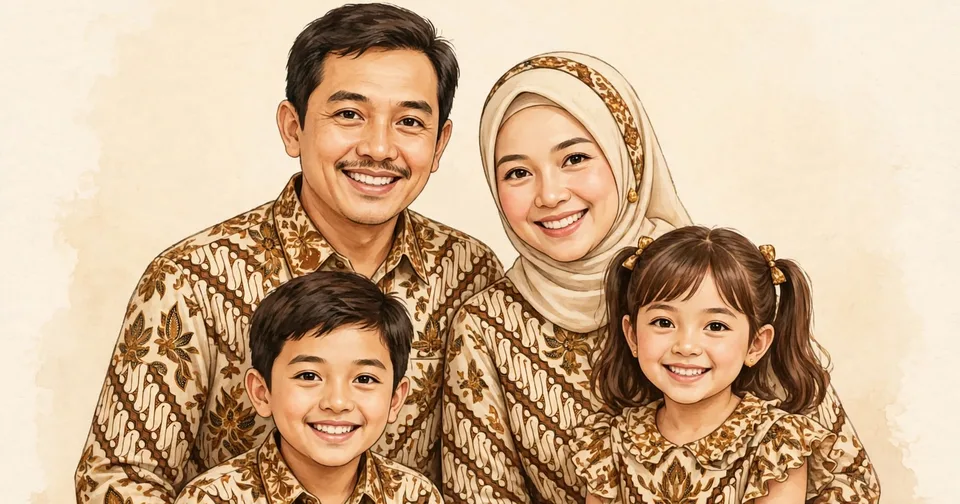
Quick summary: Family sarimbit batik that looks coordinated does not have to mean identical motifs from head to toe; the key is to unite everyone through one color palette or one motif family, then adapt each garment's style to the age and taste of each family member.
There is a special joy when a whole family appears in outfits that look like they belong together: photos look neat, the moment feels more special, and togetherness seems to gain its frame. Yet behind a beautiful sarimbit photo there is often a small debate — father wants a classic motif, mother wants soft colors, and the children refuse fabric that feels stiff. The good news is that modern sarimbit allows plenty of flexibility. By understanding the basic principles of choosing motifs, colors, and fabrics, you can look coordinated without forcing everyone to wear exactly the same outfit.
1. Modern Sarimbit: Coordinated Without Being Identical
The word sarimbit comes from Javanese and means "a pair", and it used to be identical with exactly matching cloth for husband and wife. Today its meaning has widened: family sarimbit means garments designed to relate to one another visually, not always to be exactly the same. That connection can be built in three ways: the same motif in different styles, different motifs that still belong to one family, or free motifs tied together by the same color palette. This approach lets every family member look their age and show their character, while the coordinated impression remains clearly visible. This is the foundation of sarimbit today.
2. One Color Palette as the Main Binding Element
If motifs are hard to agree on, let color be the binding element. Choose one palette of two to three complementary colors — for example the golden-brown sogan typical of Solo, indigo with a touch of white, or maroon with cream. Father can wear a shirt with a dark background, mother a dress with a light background from the same palette, and the children a combination in between. Also consider the wearer's skin tone: earth tones and sogan tend to be safe for many skin tones, while pastels look fresher for daytime photo sessions.
3. One Motif Family, Many Style Variations
The second approach is to use one motif family — for instance florals, geometrics, or classic Solo motifs such as kawung and parang in a softer version for children. A large, bold motif suits fathers and looks dignified, while the same motif at a smaller scale feels sweet on mothers and children. Understanding the character of each motif helps you compose this arrangement; you can study Solo batik motifs and their meanings before deciding. The important thing is not to mix too many motif families within one family — one big theme is enough to keep the look calm and unified.
4. Tips for Choosing for Father, Mother, and Children
Every family member has different needs that deserve respect:
- Father: a short- or long-sleeved shirt with a medium-sized motif and masculine colors; choose a fabric that does not wrinkle easily so he stays neat throughout the event.
- Mother: a dress, tunic, or modern kebaya with a softer motif; a silhouette that is comfortable to move in, for the mother who is usually the busiest during the event.
- Children: prioritize cool, sweat-absorbing fabrics such as cotton, simple styles, and a slightly loose fit so children can move freely.
- Teenagers: give them room to choose their own style as long as the color stays within the palette; teenagers who take part in the decision tend to wear it more confidently.
With this division, no one feels they are wearing a uniform, yet the family photo still looks planned.
5. Matching Sarimbit to the Occasion
Sarimbit for Lebaran (Eid al-Fitr) usually has bright, clean tones, in keeping with the festive atmosphere and extended-family photos. For a wedding celebration (kondangan), choose more formal and elegant motifs and colors. For studio photos, colors with just enough contrast against the studio backdrop will make faces stand out; avoid motifs that are too small and busy, as they seem to vibrate on camera. If sarimbit is worn for an office or community event involving many people beyond the immediate family, the principle of coordination is the same as preparing batik uniforms for offices and communities: one theme, many styles. Also adjust to the time of day — bright colors are refreshing for morning and midday, while deep colors are more graceful for the evening.
6. Handling Different Tastes Without the Drama
Differences in taste almost always appear, and that is perfectly normal. Handle them with a short discussion: agree first on the most visible element, the color palette, then let motifs and styles be each person's own choice. If a family member dislikes busy batik motifs, offer a small motif or batik with larger plain areas. For children who are fussy about clothing, involve them in choosing between two options that both fit the palette. Avoid forcing a single design on everyone just to look uniform; forced comfort shows in photos through stiff expressions.
7. Order Well in Advance and Mind the Fabric
The most common mistake is preparing sarimbit at the last minute. Stamped (cap) and hand-drawn (tulis) batik cloth is handmade, so its availability follows the production process; preparing well in advance gives you a fuller choice of motifs and enough time for sewing and fitting, especially ahead of Lebaran. Order at least a few weeks beforehand — even earlier if there are many family members. Also pay attention to the fabric for each person: cool cotton for children and active fathers, a fabric with good drape for mother's dress, and make sure every fabric is comfortable to wear for several hours. At Batik Isma, in Kampoeng Batik Laweyan, Solo, the handmade stamped (cap) and hand-drawn (tulis) batik collection is made with palm-based wax (malam); the catalog, motif photos, and color options can be requested via WhatsApp to be arranged into your family's sarimbit set.
Discover Authentic Laweyan Batik at Batik Isma
The discussion above truly comes to life when you can see and feel the cloth in person. Batik Isma is located at Jl. Nitik No. 5, Kampoeng Batik Laweyan, Solo, in the heart of a neighborhood that has lived from the batik tradition for generations. Batik Isma makes hand-drawn batik (tulis), stamped batik (cap), and natural-dye batik, accepts batik uniform orders, and runs batik-making classes for anyone who wants to try it firsthand.
Batik Isma accepts batik uniform orders for offices, schools, communities, and families, with a choice of stamped (cap), hand-drawn (tulis), or natural-dye batik. Discuss your motif, fabric, quantity, and estimated production time directly via WhatsApp.
Whether you are looking for batik to wear yourself, to give as a gift, or to wear together with family and team, feel free to ask. Tell us what you need — the event you will attend, the colors you like, or the type of batik you are after — so we can suggest the most fitting options. Collection availability and other details can change at any time, so please ask us directly for the latest information.
Want to deepen your knowledge of batik? Read also our articles on Solo batik motifs and their meanings. The better you know batik, the easier it is to choose a cloth that truly suits you and carries meaning.
Questions about the Batik Isma collection? Chat with Batik Isma on WhatsApp or visit the Catalog and Contact pages.
Frequently Asked Questions (FAQ)
Does family sarimbit batik have to use identical motifs?
It doesn't have to. Modern sarimbit only needs to be tied together by one color palette or one motif family, while styles and motif scales may differ according to the age and taste of each family member.
What colors are good for family photo sarimbit?
Earth colors such as sogan, brown, and maroon are safe for many skin tones and backgrounds. For daytime photos, bright colors such as light blue or cream give a fresh impression, as long as they stay within the agreed palette.
What batik fabric is most comfortable for children?
Cotton is the top choice for children because it is cool, absorbs sweat, and is not stiff. Choose simple styles with a slightly loose fit so children can move comfortably and not get fussy quickly during the event.
When is the best time to order sarimbit batik for Lebaran?
Preferably a few weeks before Lebaran, or earlier if there are many family members. Handmade batik requires a production process, and preparing well in advance leaves room to choose motifs, sew, and fit calmly.
How can I ask about a sarimbit set at Batik Isma?
Batik Isma is located at Jl. Nitik No. 5, Kampoeng Batik Laweyan, Solo, at point No. 42 on the Laweyan Tourist Map. The catalog, motif photos, and color options for sarimbit can be requested via WhatsApp before you visit.
Ask via WhatsApp