
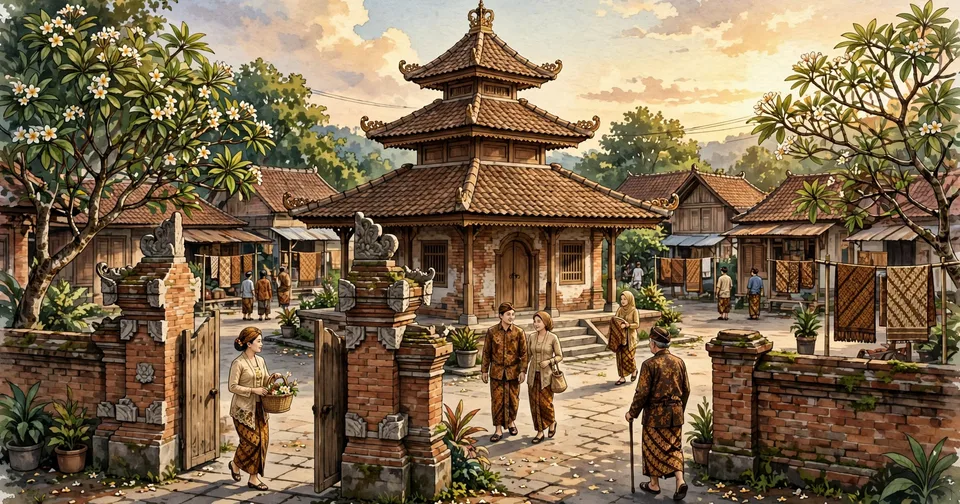
Quick summary: Masjid Laweyan is the oldest mosque in the city of Solo. It was built around 1546 during the Pajang Kingdom era, beginning as a Hindu temple on the banks of the Kabanaran River that Ki Ageng Beluk endowed as a waqf after he embraced Islam. Pioneered by Ki Ageng Henis, the mosque became a centre of Islamic preaching as well as the seed of the Laweyan community.
Strolling through Kampoeng Batik Laweyan, visitors' attention is usually drawn to the batik merchants' houses and the fabric galleries lining the lanes. Yet in the very same neighbourhood stands a building far older than the batik village itself: Masjid Laweyan. This mosque has watched Laweyan grow from perdikan land into a renowned batik centre, and its story begins with the meeting of two important figures in the 16th century.
1. The Oldest Mosque in Solo
Masjid Laweyan is known as the oldest mosque in the city of Solo. It was built around 1546, during the Pajang Kingdom under Sultan Hadiwijaya, who is also known as Jaka Tingkir. To grasp its age, this mosque was already standing long before the Great Mosque of Surakarta was built in 1763 — a gap of more than two centuries.
The mosque is also known as Masjid Ki Ageng Henis, taking the name of the figure who pioneered Islamic preaching in Laweyan. Although it is approaching five centuries old, the mosque still stands well maintained and continues to be used by the surrounding community for worship to this day.
2. It Began as a Temple on the Banks of the Kabanaran River
Before it became a mosque, this building was a Hindu temple led by Ki Ageng Beluk. It stood on the banks of the Kabanaran River — the river now known as the Jenes River — which at the time was a batik trade route, so the area was busy with merchants and travellers passing through.
Ki Ageng Beluk was a friend of Ki Ageng Henis, and the two often discussed religion and life. Out of that friendship and those discussions, Ki Ageng Beluk eventually embraced Islam together with his students. He then endowed his temple as a waqf to be made into a mosque. From then on, the building changed function into a place of worship for Muslims, and it grew into a centre of preaching and an Islamic boarding school (pesantren) for the surrounding community.
3. Ki Ageng Henis and His Preaching in the Laweyan Perdikan Land
Ki Ageng Henis was a scholar as well as an adviser to the Pajang Kingdom. According to several records, he was a student of Sunan Kalijaga and a descendant of Ki Ageng Sela, whose lineage traces back to Brawijaya V of Majapahit. He was granted the perdikan land of Laweyan — at the same time, Ki Ageng Pemanahan was granted Alas Mentaok, which later became Mataram.
On this perdikan land, Ki Ageng Henis spread Islam and built the Laweyan community, so he is regarded as the founding father of the Laweyan community as well as an ancestor of the kings of Islamic Mataram. Interestingly, according to research by Fajar Shodiq of IAIN Surakarta, Ki Ageng Henis is also remembered as a pioneer of batik in Laweyan — a thread connecting the history of this mosque with Laweyan's identity as a batik village. He is estimated to have died around 1570.
4. An Architecture of Hindu, Javanese, and Islamic Acculturation
The uniqueness of Masjid Laweyan is clearly visible in its building, which is the result of an acculturation of Hindu, Javanese, and Islamic cultures. It is only natural, since the mosque grew out of a temple: its construction still resembles a temple to this day, reflecting the peaceful cultural transition of that era.
The mosque building stands on a plot of land covering 162 square metres and is raised about 2 metres above the ground — a characteristic of ancient Hindu sacred buildings. Although it is hundreds of years old, most of the building remains original and well maintained, so visitors can still witness the early form of Solo's oldest mosque.
5. The Tomb of Ki Ageng Henis in the Mosque Complex
Within the mosque complex lies the tomb of Ki Ageng Henis, along with the tombs of royal relatives. The presence of these tombs makes the Masjid Laweyan complex not only a place of worship, but also a place to directly remember the figure who opened Islamic preaching on the perdikan land of Laweyan.
For visitors, the tomb complex completes the mosque's story: from an endowed temple, preaching that grew into a boarding school, to the Laweyan community that later became widely known for its batik. The mosque and its tombs form an inseparable unity of history.
6. A Living Cultural Heritage Site to This Day
In 2021, Masjid Laweyan was designated a cultural heritage site through a Decree of the Mayor of Solo, affirming its extraordinary historical value for the city. This status helps preserve the largely original building for future generations.
Masjid Laweyan is located at Jalan Liris I, Pajang, Laweyan, Surakarta — within the same area as Kampoeng Batik Laweyan. Travellers exploring the history of Kampoeng Batik Laweyan can stop by to see this mosque, and their visit route can be combined with the route in the Kampoeng Batik Laweyan travel guide. As a neighbour in the same village, Batik Isma is located at Jl. Nitik No. 5 and is recorded as point No. 42 on the Kampoeng Batik Laweyan Tourist Map.
Discover Authentic Laweyan Batik at Batik Isma
The discussion above truly comes to life when you can see and feel the cloth in person. Batik Isma is located at Jl. Nitik No. 5, Kampoeng Batik Laweyan, Solo, in the heart of a neighborhood that has lived from the batik tradition for generations. Batik Isma makes hand-drawn batik (tulis), stamped batik (cap), and natural-dye batik, accepts batik uniform orders, and runs batik-making classes for anyone who wants to try it firsthand.
Batik Isma accepts batik uniform orders for offices, schools, communities, and families, with a choice of stamped (cap), hand-drawn (tulis), or natural-dye batik. Discuss your motif, fabric, quantity, and estimated production time directly via WhatsApp.
Whether you are looking for batik to wear yourself, to give as a gift, or to wear together with family and team, feel free to ask. Tell us what you need — the event you will attend, the colors you like, or the type of batik you are after — so we can suggest the most fitting options. Collection availability and other details can change at any time, so please ask us directly for the latest information.
Want to deepen your knowledge of batik? Read also our articles on the history of Kampoeng Batik Laweyan and the Kampoeng Batik Laweyan travel guide. The better you know batik, the easier it is to choose a cloth that truly suits you and carries meaning.
Questions about the Batik Isma collection? Chat with Batik Isma on WhatsApp or visit the Catalog and Contact pages.
Frequently Asked Questions (FAQ)
When was Masjid Laweyan built?
Masjid Laweyan was built around 1546, during the Pajang Kingdom under Sultan Hadiwijaya (Jaka Tingkir). This age makes it the oldest mosque in the city of Solo, far older than the Great Mosque of Surakarta, which was built in 1763.
Why is it called Masjid Ki Ageng Henis?
The name comes from Ki Ageng Henis, a scholar and adviser to the Pajang Kingdom who pioneered Islamic preaching in the perdikan land of Laweyan. He is regarded as the founding father of the Laweyan community and an ancestor of the kings of Islamic Mataram, and his tomb is located in the mosque complex.
Is it true that Masjid Laweyan used to be a temple?
Yes, it is. The building began as a Hindu temple led by Ki Ageng Beluk on the banks of the Kabanaran River (now the Jenes River). After Ki Ageng Beluk embraced Islam together with his students, he endowed the temple as a waqf to be made into a mosque, which later became a centre of preaching and a boarding school.
What is unique about the architecture of Masjid Laweyan?
Its architecture is an acculturation of Hindu, Javanese, and Islamic cultures: its construction still resembles a temple, and the building is raised about 2 metres above the ground, following the style of ancient Hindu sacred buildings. Covering 162 square metres, the building is mostly still original and well maintained.
Where is Masjid Laweyan located, and can it be visited?
Masjid Laweyan is located at Jalan Liris I, Pajang, Laweyan, Surakarta, in the same area as Kampoeng Batik Laweyan. The mosque is still actively used for worship and was designated a cultural heritage site in 2021, so travellers can see it as part of a Laweyan historical tour.
Ask via WhatsApp