Quick summary: The history of batik begins in the environment of the Javanese royal courts, then spreads to the coast and society at large, until on 2 October 2009 batik was recognised by UNESCO as Intangible Cultural Heritage, and that date is celebrated as National Batik Day.
The batik we know today — worn for office shirts, school uniforms, and even wedding attire — began as a far more exclusive tradition. Its journey over centuries passed through palace walls, coastal villages, and the colonial era, until it was finally recognised by the world. Understanding the history of batik makes us appreciate every piece of cloth made with wax (malam) and the perseverance of human hands.
1. Batik's Roots in the Javanese Royal Courts
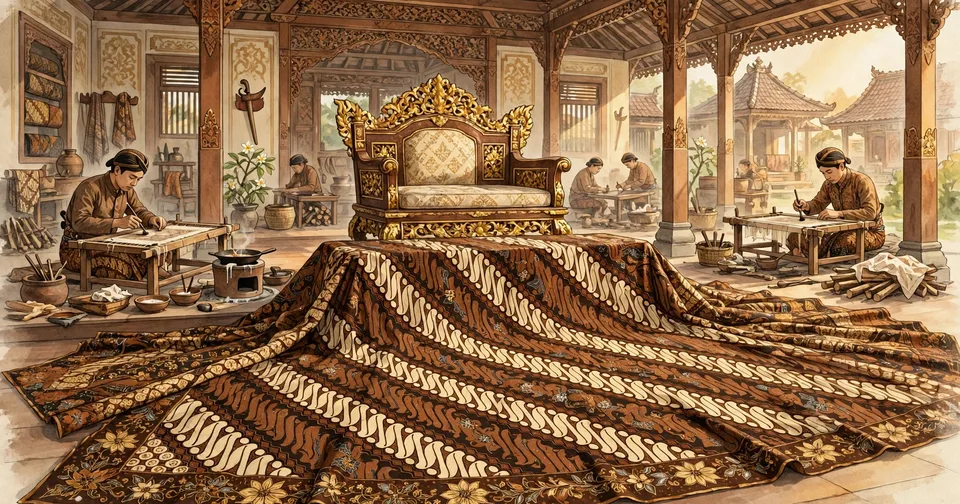
The technique of decorating cloth with a wax (malam) resist was known in various ancient civilisations, but in Java this technique developed into a very refined art within the royal courts (keraton), especially the Keraton of Surakarta and Yogyakarta. In those days, batik making was the work of the women of the palace: cloth was drawn slowly with a canting (a pen-like wax applicator) for the clothing of kings, royal families, and nobles.
Certain motifs were even forbidden, or awisan dalem — motifs that could only be worn by the king and his closest relatives, such as parang rusak and kawung in particular sizes. Every motif carries a philosophy — prayers, hopes, and the Javanese worldview — so batik is not merely cloth, but a language of symbols. Its dominant colours were also characteristic of the inland courts: calm sogan brown, indigo, and cream.
2. Spreading to the Coast and the Common People
From the courts, batik-making skills spread outward through court servants (abdi dalem) and royal families living outside the palace, then developed in batik villages such as Laweyan in Solo and Kauman in Yogyakarta and Solo. Batik no longer belonged only to the nobility; ordinary people began making and wearing it for traditional ceremonies, weddings, and daily life.
Meanwhile, on Java's north coast — Pekalongan, Cirebon, Lasem, and Tuban — batik grew with a different character. Traders from various nations brought influences of motif and colour: bright flowers characteristic of Europe, dragons and phoenixes from China, and Arabic calligraphy. Coastal batik appears bold, with striking reds, blues, greens, and yellows, in contrast to the calm inland batik.
3. The Colonial Era and the Birth of Stamped Batik (Cap)
In the 19th century, batik became a bustling trade commodity. Large market demand drove the birth of the stamped batik (batik cap) innovation around the middle of that century: a motif was drawn once onto copper, then stamped repeatedly onto cloth. This method was far faster than drawing with a canting (wax pen) piece by piece, making batik more affordable, and home-based batik industries sprang up in many cities.
At the same time, batik entrepreneurs from native Indonesian, Chinese, and Arab communities built large batik businesses. Kampung Laweyan in Solo is one piece of evidence: a batik merchants' village whose grand houses still stand today. Its story can be read in our article on the history of Kampoeng Batik Laweyan Solo, the village where Batik Isma is located to this day.
4. Batik as a National Identity
Entering the 20th century, batik was worn by figures of the national movement and became a subtle symbol of cultural resistance against colonial rule. After independence, batik became even more rooted as national dress: worn at official state events, as uniforms, and even in diplomacy. Indonesian leaders introduced batik to the international world through the batik shirts worn at global forums.
Each region then developed its own identity — the classic batik of Solo and Yogyakarta, the lively batik of Pekalongan, mega mendung from Cirebon, and batik from various regions outside Java. This diversity of motifs is discussed further in our article on Solo batik motifs and their meanings.
The role of women is also important in this journey. From the court era to home industries, the majority of batik makers have been women who passed down canting skills from mother to daughter across generations. Thanks to them, the hand-drawn batik (tulis) technique has survived through the ages, even as machine-printed cloth flooded the market at cheap prices. In many batik villages, batik making is the backbone of the family economy as well as a guardian of tradition — two roles that run side by side to this day.
5. UNESCO Recognition and National Batik Day
The peak of world recognition came on 2 October 2009, when UNESCO designated Indonesian batik as a Masterpiece of the Oral and Intangible Heritage of Humanity. What was recognised was not only the cloth, but the whole process of making batik with canting and cap (stamp), the philosophy of its motifs, and the living tradition in society.
The Indonesian government then designated 2 October as National Batik Day. Since then, wearing batik every Friday and on Batik Day commemorations has become a custom in offices, schools, and institutions across Indonesia — a new tradition that brings old heritage together with modern life.
6. Batik Today
Today batik lives in many forms: work shirts, dresses, Muslim fashion, family sarimbit (matching outfits), and even youth fashion paired with sneakers. Artisans in batik villages keep innovating — for example Batik Isma at Jl. Nitik No. 5, Kampoeng Batik Laweyan, Solo, which makes handmade stamped (cap) and hand-drawn (tulis) batik using palm-based wax (malam). The spirit remains the same as centuries ago: drawing with wax, dyeing with patience, and passing a story on through a piece of cloth — in line with its tagline, "Elegansi Tradisi, Gaya Masa Kini" ("The Elegance of Tradition, the Style of Today").
Discover Authentic Laweyan Batik at Batik Isma
The discussion above truly comes to life when you can see and feel the cloth in person. Batik Isma is located at Jl. Nitik No. 5, Kampoeng Batik Laweyan, Solo, in the heart of a neighborhood that has lived from the batik tradition for generations. Batik Isma makes hand-drawn batik (tulis), stamped batik (cap), and natural-dye batik, accepts batik uniform orders, and runs batik-making classes for anyone who wants to try it firsthand.
Batik Isma accepts batik uniform orders for offices, schools, communities, and families, with a choice of stamped (cap), hand-drawn (tulis), or natural-dye batik. Discuss your motif, fabric, quantity, and estimated production time directly via WhatsApp.
Whether you are looking for batik to wear yourself, to give as a gift, or to wear together with family and team, feel free to ask. Tell us what you need — the event you will attend, the colors you like, or the type of batik you are after — so we can suggest the most fitting options. Collection availability and other details can change at any time, so please ask us directly for the latest information.
Want to deepen your knowledge of batik? Read also our articles on history of Kampoeng Batik Laweyan Solo and Solo batik motifs and their meanings. The better you know batik, the easier it is to choose a cloth that truly suits you and carries meaning.
Questions about the Batik Isma collection? Chat with Batik Isma on WhatsApp or visit the Catalog and Contact pages.
Frequently Asked Questions (FAQ)
When was batik recognised by UNESCO?
Indonesian batik was recognised by UNESCO on 2 October 2009 as Intangible Cultural Heritage of Humanity. That date was then designated as National Batik Day.
What is the difference between inland and coastal batik?
Inland batik (Solo and Yogyakarta) is coloured in sogan brown, indigo, and cream with classic motifs full of court philosophy. Coastal batik (Pekalongan, Cirebon, Lasem) is brightly coloured with flora and fauna motifs influenced by trading cultures from various nations.
When did stamped batik (cap) start being used?
Stamped batik (batik cap) developed around the middle of the 19th century to meet large market demand. The stamping technique made production faster and batik more affordable, without removing the wax process as a colour resist.
Why are some batik motifs called forbidden?
In the Javanese courts, certain motifs such as parang rusak and large-sized kawung could only be worn by the king and his closest family. These motifs are called awisan dalem and indicated the status of the wearer.
Where can I see a historic batik village?
One of them is Kampoeng Batik Laweyan in Solo, a batik merchants' village since the colonial era that is still actively making batik today. Batik Isma is located there, at point No. 42 of the Laweyan Tourist Map.
Ask via WhatsApp