
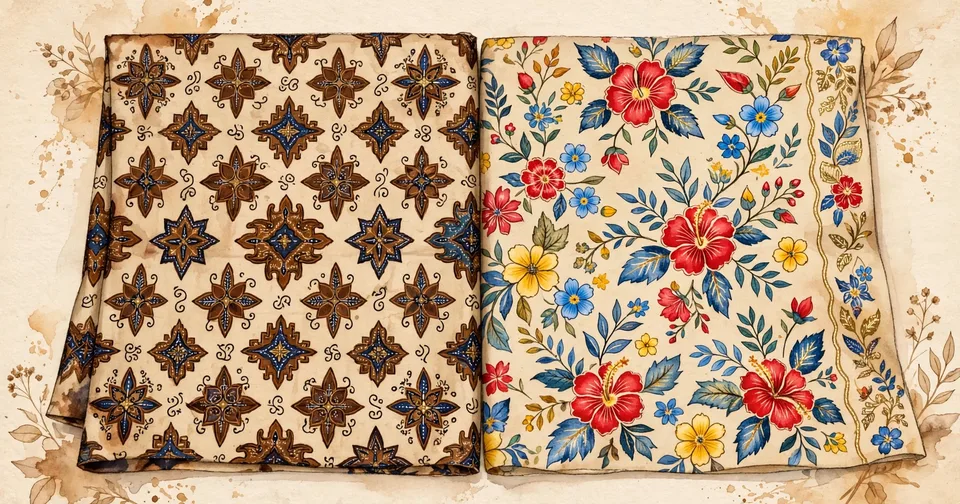
Quick summary: The difference between coastal and inland batik lies in their colors, motifs, and cultural background: inland batik from Solo and Yogyakarta wears calm sogan colors with classic court motifs, while coastal batik from Pekalongan, Cirebon, and Lasem wears bright colors with free flora and fauna motifs.
Indonesia has an extraordinarily rich variety of batik. Amid that diversity, batik observers have long grouped it into two great families: inland batik (pedalaman) and coastal batik (pesisir). This grouping is not about which is better, but a way of understanding how the environment, history, and culture of its makers shape the character of a piece of cloth. By getting to know both, we can choose batik more easily while appreciating the story behind it.
1. Two Great Families of Indonesian Batik
The term inland (pedalaman) refers to batik that developed in the inland regions of Java, especially Solo and Yogyakarta, centered on court (keraton) culture. The term coastal (pesisir) refers to batik from port cities on Java's north coast such as Pekalongan, Cirebon, and Lasem, which have long been meeting places for traders of many nations.
These different environments gave birth to two contrasting characters. Inland batik grew within the refined, symbolic rules and conventions (pakem) of the palace, while coastal batik grew in an open, dynamic trading atmosphere. Both can be recognized simply by paying attention to the cloth's base color and motif style, even by eyes that are new to batik.
2. Inland Batik: Sogan Colors and Classic Court Motifs
The easiest feature of inland batik to recognize is its color palette: sogan brown (sogan, the traditional brown dye of Solo and Yogyakarta), indigo, black, and cream, all warm and calm. The distinctive sogan color of Solo and Yogyakarta is obtained from a traditional brown dye and remains a strong identity of court batik to this day.
Its motifs are generally classic, geometric, and arranged symmetrically with regular repetition. Names such as kawung and parang are among the best-known classic motifs from the inland tradition, and in the past certain motifs within the court were even regulated in their use. The overall impression is graceful and full of calm, radiating dignity. A fuller explanation can be read in the article on Solo batik motifs and their meanings.
3. Coastal Batik: Bright Colors from Port Cities
In contrast, coastal batik dares to play with color: bright red, vivid blue, green, yellow, purple, and even combinations of many colors in a single cloth. This freedom of color was born of coastal communities that openly received the influence of Chinese, Arab, Indian, and European traders who stopped at their ports.
Its motifs are dominated by flora and fauna drawn more freely: flower arrangements in the buketan style typical of Pekalongan show a European touch, mega mendung from Cirebon depicts iconic layered clouds, and Lasem batik is known for its bold red color. The impression is cheerful and alive, like the harbor atmosphere where it was born.
4. How to Tell Them Apart by Color and Motif
For beginners, there is a practical way to distinguish the two without memorizing motif names:
- Look at the base color: muted sogan brown, indigo, and cream point to inland; bright and varied colors point to coastal.
- Notice the motif: symmetrical, regularly repeated geometric patterns are an inland trait; free drawings of flowers, birds, and butterflies are a coastal trait.
- Feel the impression: inland feels calm and formal, coastal feels cheerful and relaxed.
- Look at the motif filling detail: inland tends to be dense and fine, following the pakem; coastal is looser and more spontaneous.
Of course, some cloth falls between the two, because batik makers keep creating and influencing one another. An area such as Kampoeng Batik Laweyan in Solo, whose story is told in the article on the history of Kampoeng Batik Laweyan Solo, is an example of how the inland tradition stays alive and keeps developing in the hands of artisans to this day.
5. The Cultural Influences Behind Both
In the inland regions, the keraton (court) was the center of culture: batik was made for the palace environment with strong rules, etiquette, and Javanese philosophical values. The process emphasized precision and patience, and many motifs were handed down through generations.
On the coast, the harbor was the center: batik cloth was a trade commodity that had to attract buyers of many backgrounds. Coastal batik makers quickly absorbed market tastes and the cultures of newcomers into their motifs. Inland batik was born of a guarded culture, coastal batik of a fluid meeting of cultures; both are historical records written with a canting and malam (wax).
6. Modern Ways to Wear Each
In present-day wear, the character of each can be put to use according to the mood. Sogan-colored inland batik is perfect for formal events, office work, ceremonies, and moments that call for a dignified impression; a sogan shirt with a neat cut is the classic example.
Bright coastal batik suits relaxed and creative settings: family events, outings, community gatherings, and casual weekend outfits. A floral coastal blouse can become the center of attention without needing many accessories. Many people combine both in one wardrobe: inland for important days, coastal for lighter days.
7. Both Are Equally Valuable
It is important to underline: this difference is not a ranking. Inland batik is valuable for the depth of its tradition and the refinement of its pakem, while coastal batik is valuable for its courage in color and its openness to the world. Both are worked with equally serious technique, especially in handmade hand-drawn batik (tulis) and stamped batik (cap).
Batik Isma, based at Jl. Nitik No. 5, Kampoeng Batik Laweyan, Solo and located at point No. 42 on the Laweyan Tourist Map, carries on the inland tradition through handmade stamped batik (cap) and hand-drawn batik (tulis) made with palm-based malam (wax), under the tagline "Elegansi Tradisi, Gaya Masa Kini" (The Elegance of Tradition, the Style of Today). Its catalog, photos, and collection prices can be asked via WhatsApp. Whichever batik family you choose, buying an artisan's work means helping keep Indonesia's cultural heritage alive.
Discover Authentic Laweyan Batik at Batik Isma
The discussion above truly comes to life when you can see and feel the cloth in person. Batik Isma is located at Jl. Nitik No. 5, Kampoeng Batik Laweyan, Solo, in the heart of a neighborhood that has lived from the batik tradition for generations. Batik Isma makes hand-drawn batik (tulis), stamped batik (cap), and natural-dye batik, accepts batik uniform orders, and runs batik-making classes for anyone who wants to try it firsthand.
Batik Isma accepts batik uniform orders for offices, schools, communities, and families, with a choice of stamped (cap), hand-drawn (tulis), or natural-dye batik. Discuss your motif, fabric, quantity, and estimated production time directly via WhatsApp.
Whether you are looking for batik to wear yourself, to give as a gift, or to wear together with family and team, feel free to ask. Tell us what you need — the event you will attend, the colors you like, or the type of batik you are after — so we can suggest the most fitting options. Collection availability and other details can change at any time, so please ask us directly for the latest information.
Want to deepen your knowledge of batik? Read also our articles on Solo batik motifs and their meanings and history of Kampoeng Batik Laweyan Solo. The better you know batik, the easier it is to choose a cloth that truly suits you and carries meaning.
Questions about the Batik Isma collection? Chat with Batik Isma on WhatsApp or visit the Catalog and Contact pages.
Frequently Asked Questions (FAQ)
What is the easiest difference between coastal and inland batik to see?
The colors and motifs. Inland uses sogan, indigo, and cream with symmetrical classic geometric motifs, while coastal uses varied bright colors with free flora and fauna motifs.
Which regions are famous as producers of coastal batik?
Pekalongan, Cirebon, and Lasem are the three best-known names. Pekalongan is famous for its buketan flower motifs, Cirebon for mega mendung, and Lasem for its distinctive red color.
Why is inland batik identified with the sogan color?
Because Solo and Yogyakarta batik developed in a court environment with the traditional sogan brown dye and pakem guarded through generations. That calm palette reflects the refined, symbolic character of palace culture.
Which is better, coastal or inland batik?
Neither is better; both are equally valuable with different characters. Inland excels in depth of tradition and a formal impression, coastal excels in bright colors and a cheerful impression — it simply comes down to your taste and the occasion.
Can both types of batik be made with the tulis and cap techniques?
Yes. The coastal–inland difference is about motif style and color, not technique; both can be made with a canting as hand-drawn batik (tulis) or with a stamp (cap), and their quality is determined by the materials and the care of their makers.
Ask via WhatsApp