
Quick summary: What you learn in a batik class at Kampoeng Batik Laweyan, who it is suitable for, and what you need to prepare.
Buying batik is fun, but making your own batik gives a far more memorable experience. At Kampoeng Batik Laweyan, Solo, many visitors take the time to learn batik: holding a canting (the pen-like wax tool), breathing in the aroma of the wax (malam), and watching white cloth slowly turn into a patterned work of art. This article discusses what is learned, who it suits, and what to prepare.
Why Learn Batik?
- Understanding the process behind the cloth. After trying it yourself, you will understand why hand-drawn batik (tulis) is so valuable.
- A calming creative activity. Drawing with the canting requires focus and patience — much like meditation.
- A personal keepsake. You can take your finished work home.
- Cultural education. Suitable for children, students, and families alike.
- A group activity. Many offices and communities choose batik-making as a bonding activity.
What Will You Learn?
The material may differ from place to place, but generally includes:
Introduction to Batik
The instructor explains a brief history, the types of batik (hand-drawn/tulis, stamped/cap, and combinations), the tools and materials, and the difference between batik and printed fabric.
Drawing the Pattern
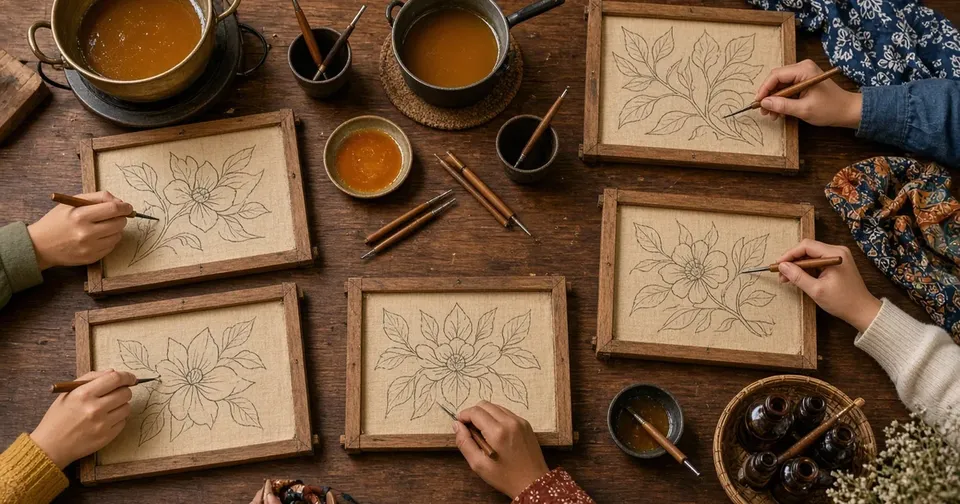
Participants draw or trace a simple pattern onto the cloth with a pencil. Beginners usually start with flower or leaf motifs, or geometric shapes.
Applying Wax with the Canting
This is the most fun and most challenging part. Participants learn to scoop up the liquid wax, blow on the canting's spout, then draw it along the pattern. Accidental drips of wax are completely normal for beginners.
Coloring
Depending on the package, participants can color with the dip-dye technique (celup) or colet (painting specific areas with a brush).
Wax Removal (Lorod) and Finishing
The cloth is boiled to dissolve the wax — a step called lorod — then washed and dried. In short classes, this stage is sometimes assisted by the instructor.
Types of Batik Classes
- Short class: suitable for tourists with limited time, usually making a small work such as a handkerchief.
- Half-day or full-day class: a more complete process with a larger piece of cloth.
- Group class: for schools, offices, or communities.
- Ongoing course: for those who want to study batik technique seriously and in depth.
Durations, materials, and class terms differ at each organizer, so ask for the details before you come.
Who Is It Suitable For?
- Tourists who want an authentic experience in Solo.
- Children and students, for cultural education. Make sure they are accompanied, because the liquid wax is hot.
- Families looking for an activity to do together.
- Office workers and communities, for bonding activities.
- Designers and craft lovers who want to understand batik technique.
Preparation Before the Class
- Wear clothes you don't mind getting stained by wax or dye.
- Bring an apron if one is not provided.
- Prepare a simple motif idea. For beginners, simple motifs give more satisfying results.
- Confirm the schedule and capacity, especially for large groups.
- Arrive on time, because some stages require drying time.
Tips for Better Results
- Hold the canting at a slight tilt and don't press the cloth too hard.
- Blow on the canting's spout before drawing so the wax doesn't drip.
- Draw slowly and consistently.
- Don't worry if the lines are imperfect — that is exactly the character of hand-drawn batik (tulis).
- Ask the instructor if the wax is too hot or too cold.
Discover Authentic Laweyan Batik at Batik Isma
The discussion above truly comes to life when you can see and feel the cloth in person. Batik Isma is located at Jl. Nitik No. 5, Kampoeng Batik Laweyan, Solo, in the heart of a neighborhood that has lived from the batik tradition for generations. Batik Isma makes hand-drawn batik (tulis), stamped batik (cap), and natural-dye batik, accepts batik uniform orders, and runs batik-making classes for anyone who wants to try it firsthand.
Batik Isma accepts batik uniform orders for offices, schools, communities, and families, with a choice of stamped (cap), hand-drawn (tulis), or natural-dye batik. Discuss your motif, fabric, quantity, and estimated production time directly via WhatsApp.
Whether you are looking for batik to wear yourself, to give as a gift, or to wear together with family and team, feel free to ask. Tell us what you need — the event you will attend, the colors you like, or the type of batik you are after — so we can suggest the most fitting options. Collection availability and other details can change at any time, so please ask us directly for the latest information.
Questions about the Batik Isma collection? Chat with Batik Isma on WhatsApp or visit the Catalog and Contact pages.
Frequently Asked Questions (FAQ)
Can beginners join a batik class?
Yes. Most classes are designed for beginners.
Are children allowed to join?
Yes, with accompaniment, because the liquid wax is quite hot.
Can I take my work home?
Usually yes, depending on the organizer's terms and drying time.
How long does a batik class take?
It varies, from a short class to a full day. Ask the organizer directly.
What should I bring to a batik class?
Comfortable clothes you don't mind getting stained, an apron if one is not provided, and patience. Also prepare your phone to document the process from pattern to finished cloth.
Is a batik class suitable for office activities?
Very suitable. Batik-making trains focus and teamwork, and the finished work can become a team keepsake. Ask the organizer about participant capacity and available schedules.
Ask via WhatsApp