Quick summary: A checklist for ordering batik uniforms: deciding the motif, fabric, sizes, and schedule so office or community uniforms look neat and truly uniform.
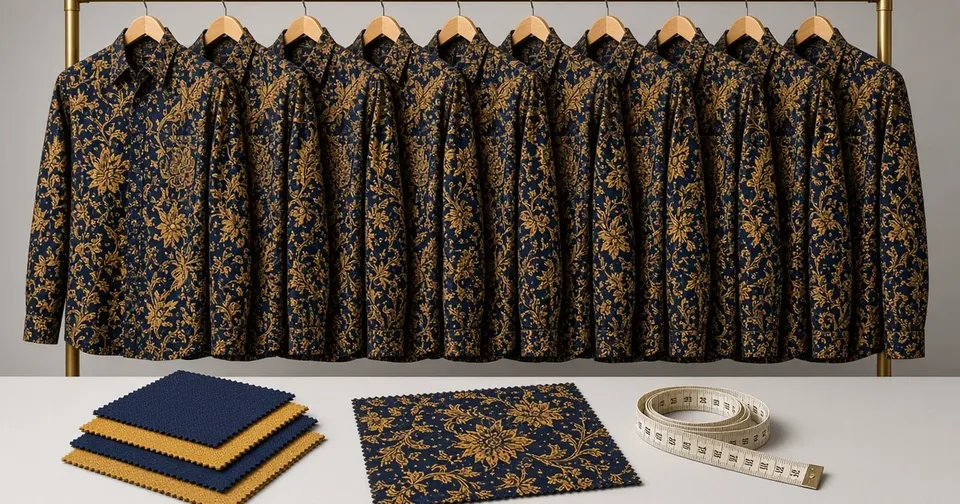
Batik uniforms make a team look coordinated while showing an identity rooted in culture. Many offices, schools, communities, and even extended families order batik uniforms for batik day, annual events, or official occasions. However, ordering uniforms requires planning so the result is neat, the sizes fit, and everything is finished on time. Here is the checklist to prepare.
1. Define the Purpose and Occasions of Use
Initial questions that need answering:
- Will the uniforms be worn routinely every week, or only for certain events?
- Will they be worn in air-conditioned rooms or outdoors?
- Must they match the identity colors of the institution or community?
These answers will determine the type of batik, fabric, and style you choose.
2. Choose the Type of Batik
- Stamped batik (cap): a popular choice for uniforms because the motif is consistent and production is more efficient in large quantities.
- Combination stamped and hand-drawn batik (cap and tulis): adds a handcrafted touch to the details, suitable for uniforms that want to look more special.
- Hand-drawn batik (tulis): suitable for limited uniforms such as the core committee or a very special occasion.
Discuss with the artisan which type best suits your needs and schedule.
3. Decide the Motif
There are two main options:
Existing Motifs
Choosing from classic motifs or the artisan's collection. This route is faster and more practical.
Custom Motifs
A motif made specially to contain elements of identity — for example a stylized logo shape, a regional icon, or the institution's philosophy. A custom motif brings its own sense of pride, but it requires a longer design and approval time, especially if a new stamp (cap) needs to be made.
Tip: avoid inserting the logo in full and too large. A logo worked into a batik ornament usually looks more elegant.
4. Choose the Colors
- Match the institution's identity colors, but still consider visual comfort.
- For men and women, the colors can be the same with slightly different motifs, or the same motif in different colors.
- Ask for color samples on real cloth, because colors on a screen can differ from the dyeing result.
5. Choose the Fabric
- Primissima cotton: smooth and cool, suitable for offices.
- Prima cotton: thicker, comfortable for daily wear.
- Other fabrics according to needs and budget.
Ask for fabric swatches so you can feel and try them before deciding.
6. Collect Size Data Neatly
This is often a source of problems. Tips to keep size data accurate:
- Use a standard size chart (S, M, L, XL, and so on) from the tailor or artisan.
- Provide sample garments for team members to try on.
- For special sizes, measure directly the chest circumference, body length, and sleeve length.
- Separate men's and women's styles, as well as long- or short-sleeve choices.
- Make sure there is one coordinator who collects and checks the data.
7. Decide the Style and Sewing Details
- Men's shirts, long or short sleeves, with or without lining (furing).
- Women's styles: shirts, tunics, blouses, or dresses.
- Additional details such as embroidered names or a small logo on the chest.
8. Build a Schedule with Buffer Time
Ask the artisan for an estimated production time from the start, then add buffer time for design revisions, samples, and size adjustments. Do not order close to the event date.
9. Request a Sample Before Mass Production
A sample helps ensure the color, motif, fabric, and size match expectations. This is an important step to avoid disappointment.
Discover Authentic Laweyan Batik at Batik Isma
The discussion above truly comes to life when you can see and feel the cloth in person. Batik Isma is located at Jl. Nitik No. 5, Kampoeng Batik Laweyan, Solo, in the heart of a neighborhood that has lived from the batik tradition for generations. Batik Isma makes hand-drawn batik (tulis), stamped batik (cap), and natural-dye batik, accepts batik uniform orders, and runs batik-making classes for anyone who wants to try it firsthand.
Batik Isma accepts batik uniform orders for offices, schools, communities, and families, with a choice of stamped (cap), hand-drawn (tulis), or natural-dye batik. Discuss your motif, fabric, quantity, and estimated production time directly via WhatsApp.
Whether you are looking for batik to wear yourself, to give as a gift, or to wear together with family and team, feel free to ask. Tell us what you need — the event you will attend, the colors you like, or the type of batik you are after — so we can suggest the most fitting options. Collection availability and other details can change at any time, so please ask us directly for the latest information.
Questions about the Batik Isma collection? Chat with Batik Isma on WhatsApp or visit the Catalog and Contact pages.
Frequently Asked Questions (FAQ)
What type of batik is suitable for uniforms?
Stamped batik (cap), or a combination of stamped and hand-drawn batik, is generally the most practical for large quantities.
Can we make a custom motif for the office?
Yes, but it requires longer design and approval time. Discuss it with the artisan.
How do we collect accurate sizes?
Use a size chart, provide sample garments to try on, and appoint one coordinator.
When should we start ordering?
Well in advance. Ask the artisan for an estimated production time and allow buffer time.
Ask via WhatsApp